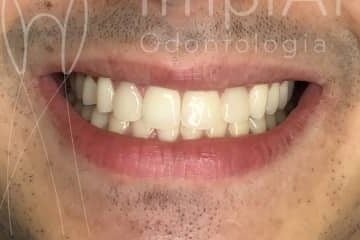
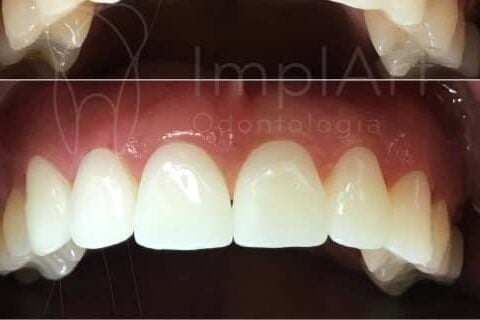
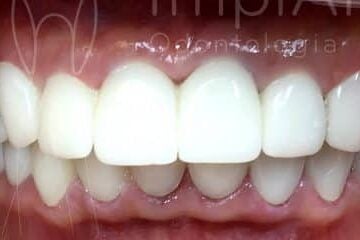
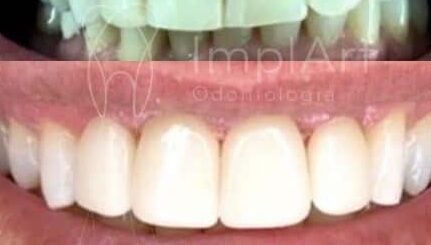
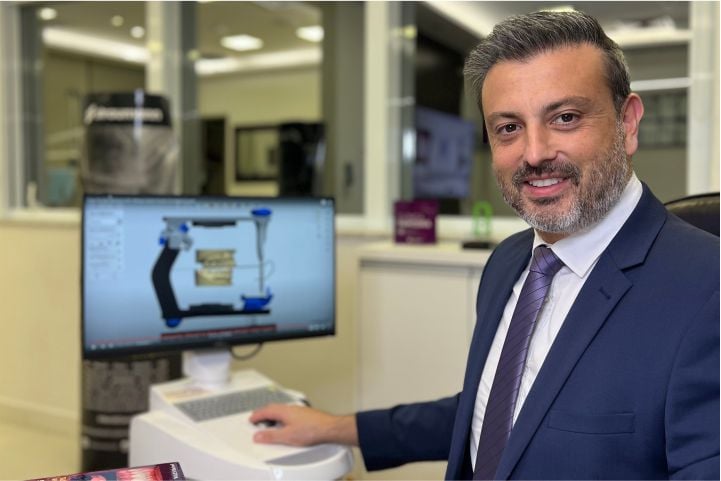
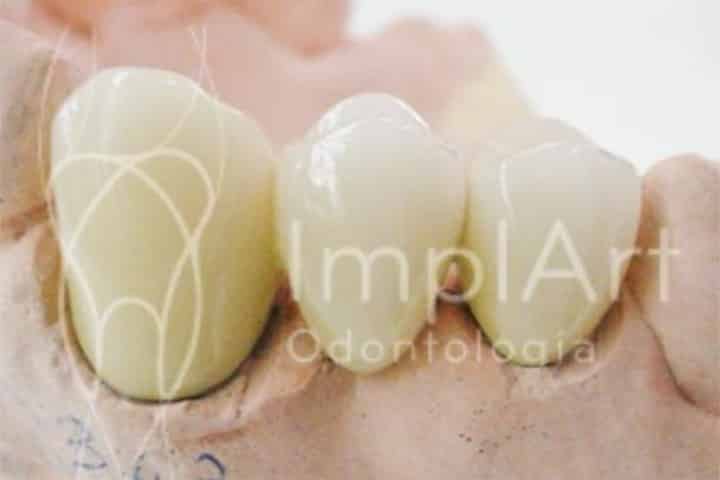
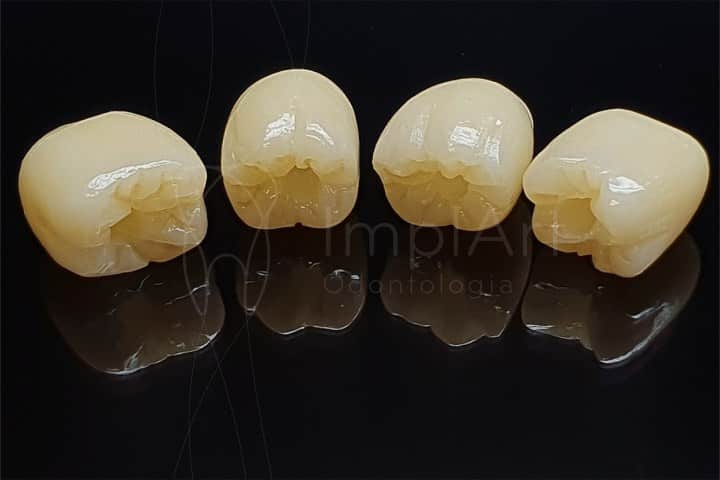
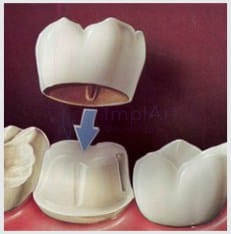
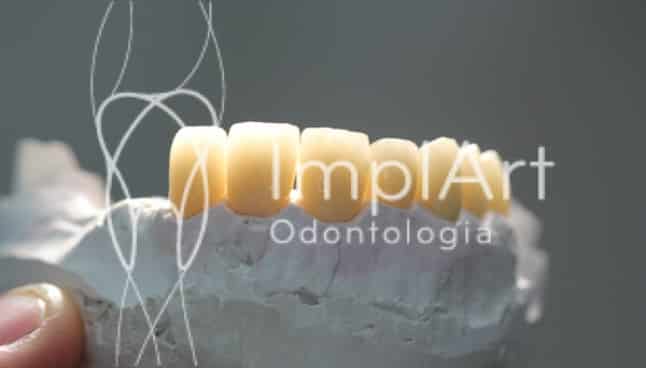
A Clínica Dentária ImplArt possui um laboratório de prótese dentária próprio, ou seja, integrado ao consultório. Dessa forma, podemos oferecer aos nossos pacientes tratamentos odontológicos mais rápidos e próteses cada vez mais precisas de acordo com cada necessidade.
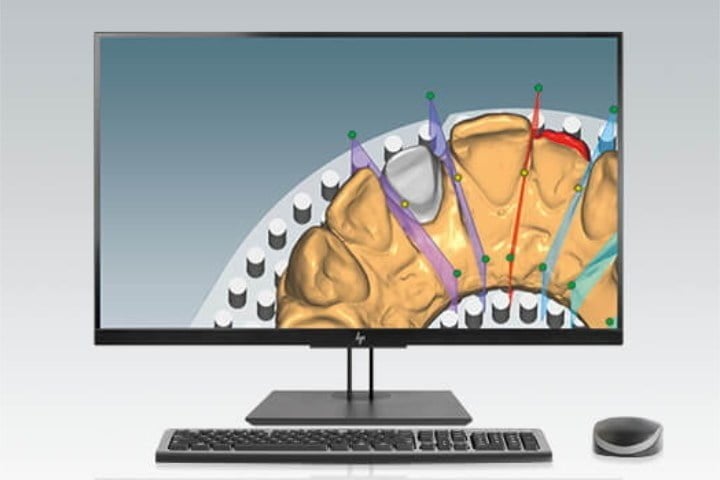
Nosso laboratório interno é equipado com os mais modernos sistemas computadorizados, como por exemplo o sistema alemão Cerec Sirona e a austríaca Ceramill Motion II AmannGirrbach. Ambos os sistemas são compostos com softwares de última geração e impressoras 3D de dentes. Além disso, contamos com a mais moderna impressora 3D UltraCraft ChairSide Pro, com agilidade e precisão na impressão de próteses.
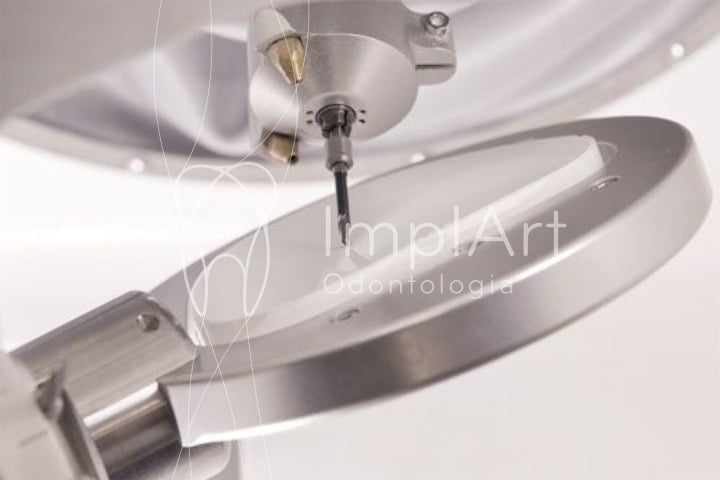
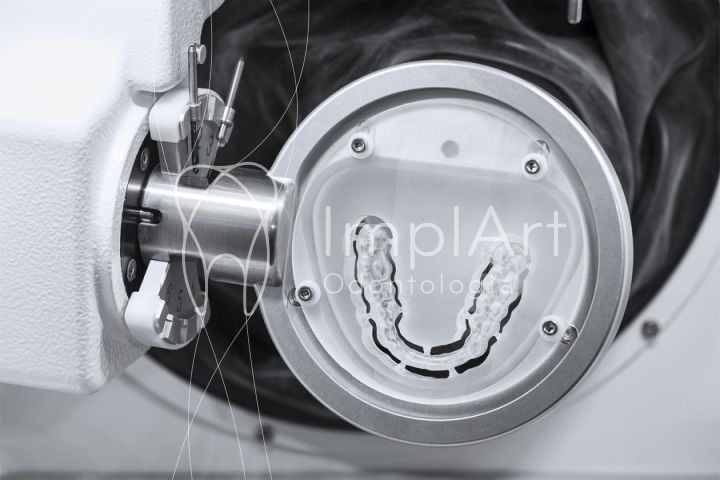
As impressoras 3D de dentes esculpem diversos tipos de próteses dentárias em bloco bruto de porcelana de acordo com projeto computadorizado personalizado para cada paciente, de Zirconia pura monolítica ou de resina. Os sistemas digitais de nosso laboratório de prótese dentária tornam os trabalhos protéticos mais rápidos e a comunicação mais precisa. Isto pode ser aplicado tanto para protese fixa, quanto para prótese protocolo sobre implante dentario, ou mesmo para coroa dentaria unitária ou proteses removiveis, as dentaduras.
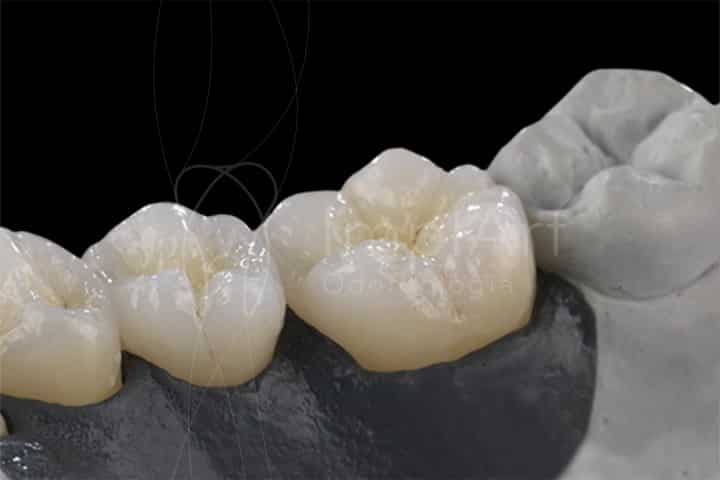
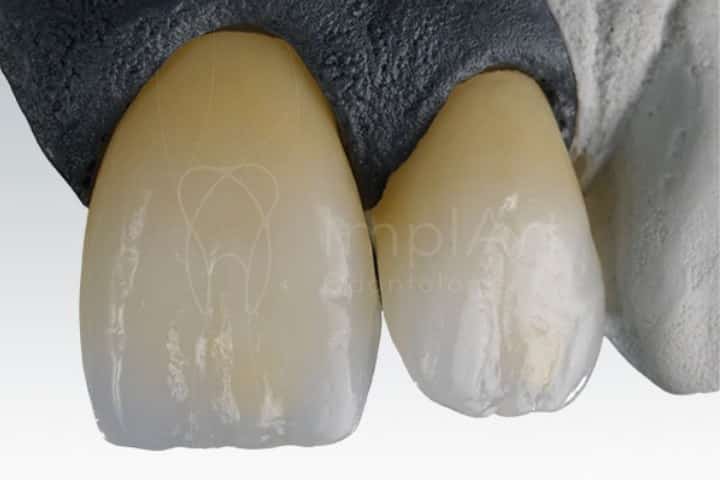
Nosso laboratório de prótese - alta tecnologiaNosso laboratório de prótese - alta tecnologiaNosso laboratório de prótese - alta tecnologiaNosso laboratório de prótese - alta tecnologiaNosso laboratório de prótese - alta tecnologiaNosso laboratório de prótese - alta tecnologiaNosso laboratório de prótese - alta tecnologiaNosso laboratório de prótese - alta tecnologiaNosso laboratório de prótese - alta tecnologia
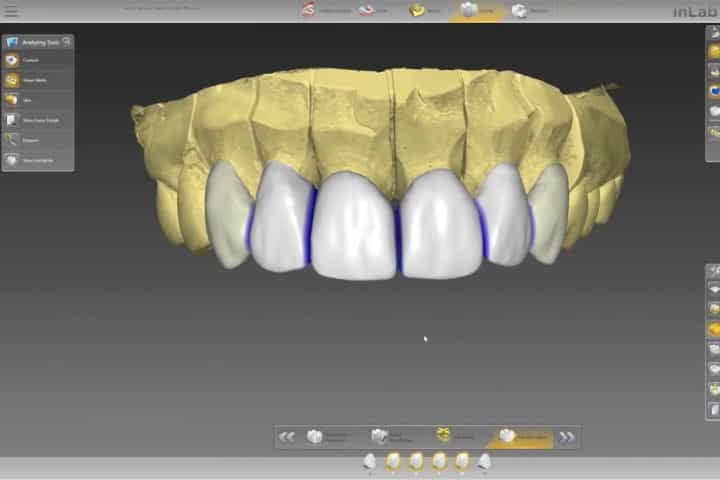
Todos os sistemas são baseados no sistema Cad/Cam, em que o modelo é escaneado em leitores por contato ou então por raios lasers. Todas as informações coletadas pelo computador são enviadas pela internet. Dessa forma, as próteses são produzidas de forma individual por robôs (impressoras 3d de dentes). Nosso laboratório de prótese dentária pode realizar uma gama de procedimentos com alta qualidade como por exemplo:
Translucent cubic zirconia is an evolution of conventional dental zirconia. Dental zirconia is increasingly being used as a material for making a dental crown or even for a fixed prosthesis on dental implants. As our dental Clinic is integrated with a dental Lab in Sao Paulo-Brazil, we can easily delivery zirconia crowns in a new days. Translucent Zirconia has certainly come to revolutionize the way dental prostheses are made, since it uses modern computer graphics resources to design the prostheses, and modern 3D milling machines to sculpt them.This makes treatment faster and more comfortable for the patient.
More about Translucent Zirconia crowns
In addition, Zirconia is the most resistant material compared to other types of crownsand allows for results with a high degree of naturalness, being the most similar to the appearance of natural teeth.
First and foremost, one of the greatest advantages of the Pure Zirconia dental crown is its strength and durability.In addition, its modern execution method, which doesn’t require the old mass moldings and only uses a 3D scanner, makes the treatment much more comfortable for the patient.It is therefore an excellent option for those who want metal-free treatment, a situation that is highly valued today with biological dentistry.
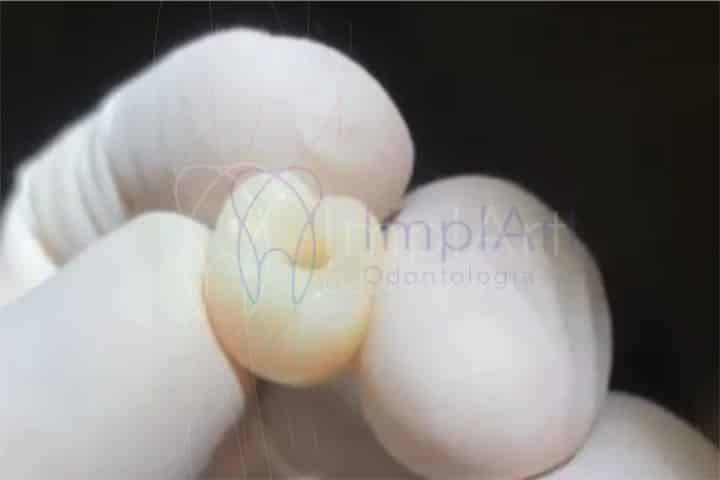
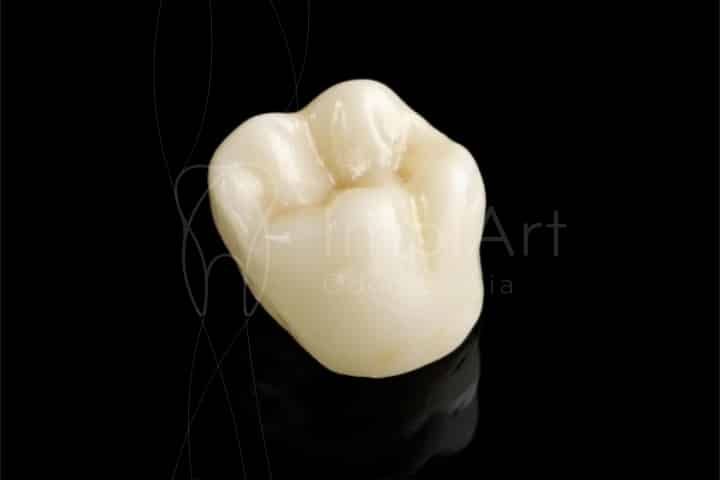
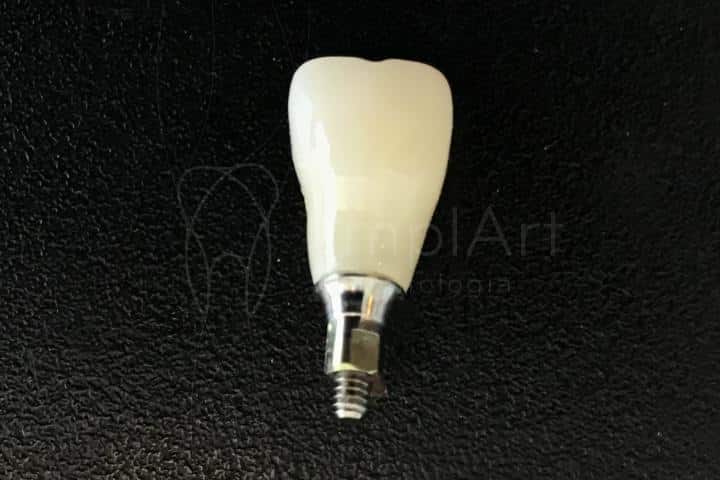
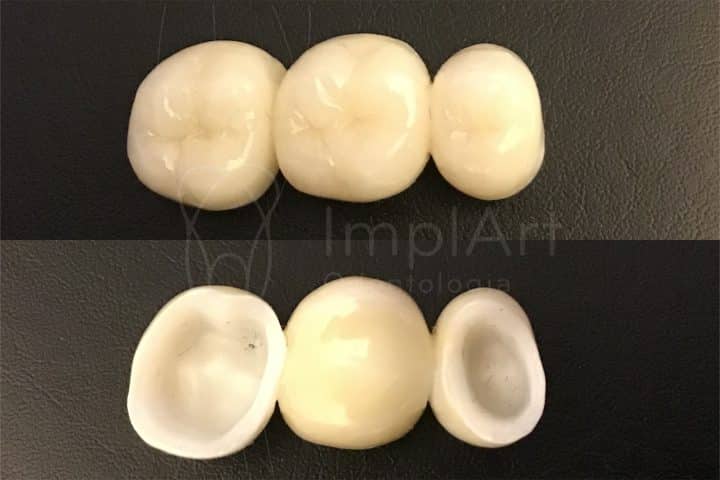
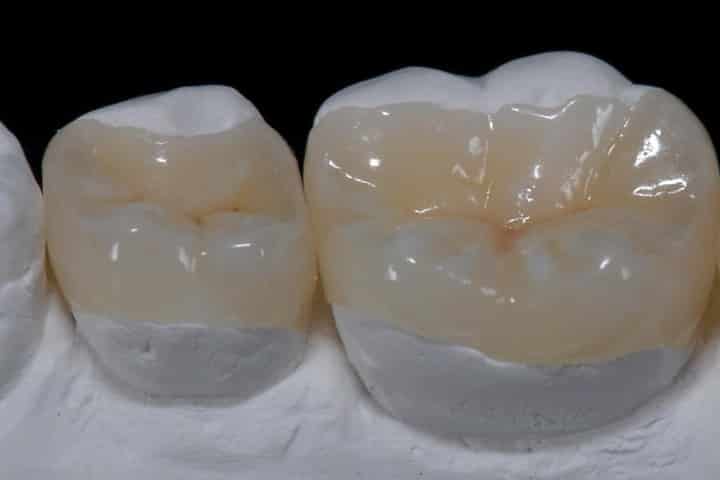
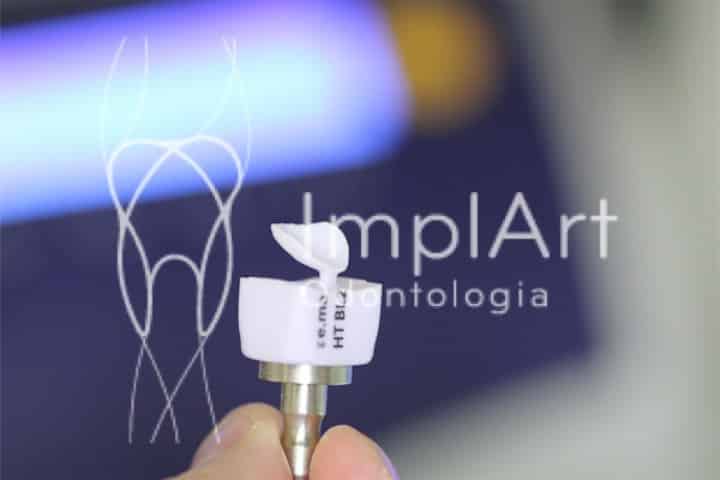
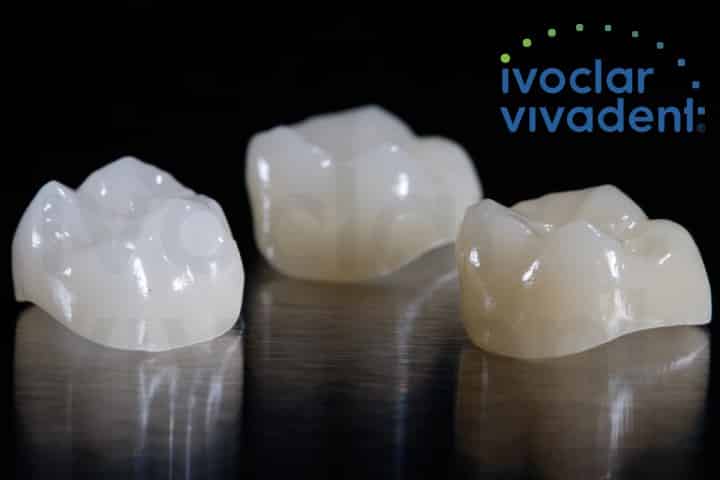
Translucent cubic zirconia crown for molar tooth (bottom), with hole for screwing into dental implant
These zirconia structures can be used both for implant prostheses, types of crowns on implants and for crowns on natural teeth.One of the pioneering companies in the development of durable and aesthetic zirconia dental prostheses is the Austrian company AmannGirrbach.Now it is introducing a new type of dental ceramic: Zolid FX translucent cubic zirconia.
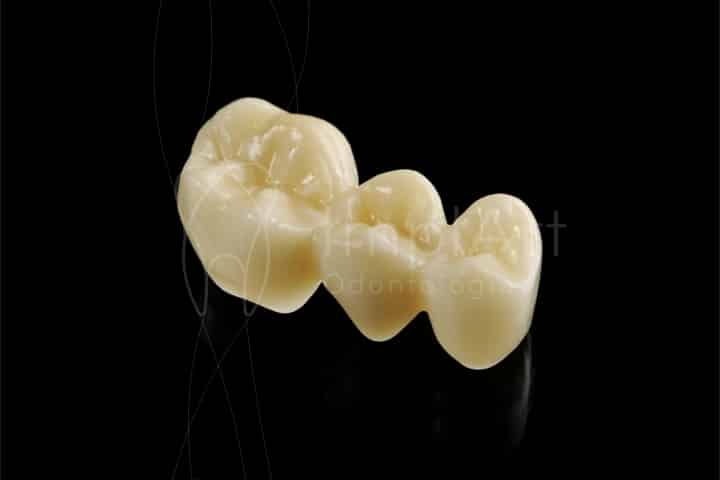
It is a fully biocompatible material used to make first-rate prosthetic crowns, not only single-unit, but also bridges of up to 3 units. The main characteristics of Zolid FX are its super-high translucency, high strength and long-term stability.
It is therefore a strong alternative to the already established lithium disilicate (glass ceramic), and can therefore be especially suitable for cases that require high porcelain crown strength. Cubic zirconia crowns can be installed both anteriorly with excellent aesthetics and posteriorly. They can also be used in dental implant treatment.
What is the manufacturing process like?
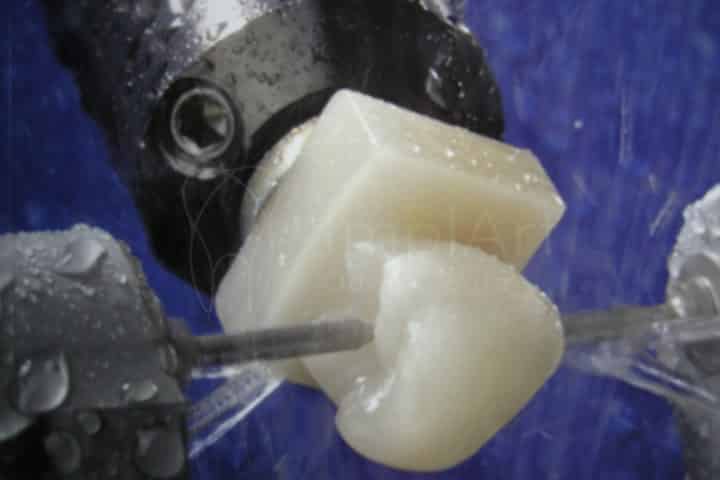
The Zolid FX cubic zirconia crown is made using computerized CAD/CAM equipment.It starts with milling the rough block on a 3D printer to the shape of the tooth.The zirconia crown is finished with the manual addition of colors and shading so that the crown has natural visual characteristics, like the neighboring teeth.The pure zirconia crown is super aesthetic and is up to 10 times stronger than ordinary (feldspatica) porcelain.
Translucent cubic zirconia crowns are suitable for bruxism patients due to their resistance
Bruxism is an oral functional disorder characterized by involuntary grinding or clenching of the teeth. The excessive force generated by bruxism can cause not only muscle and joint pain in simpler cases, but also the destruction of part of the tissues (bone and gum), enamel or the structure of the dental crown in more advanced cases.
It is important to remember that before your permanent porcelain crown is made, you will receive a temporary crown. This is used to check the aesthetics and chewability of the permanent crown.
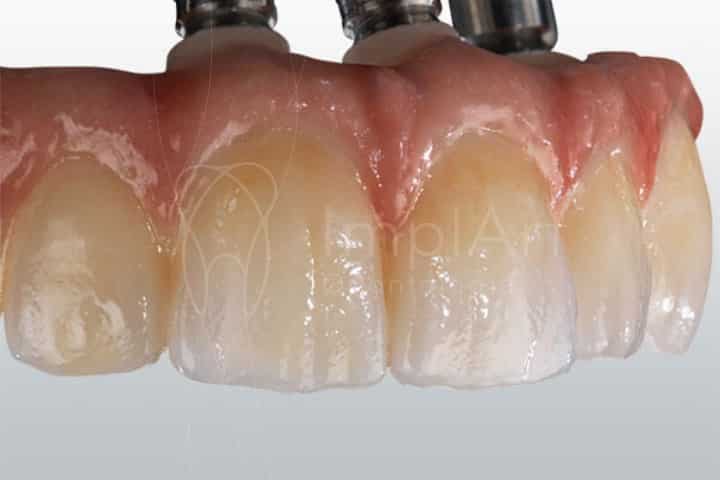
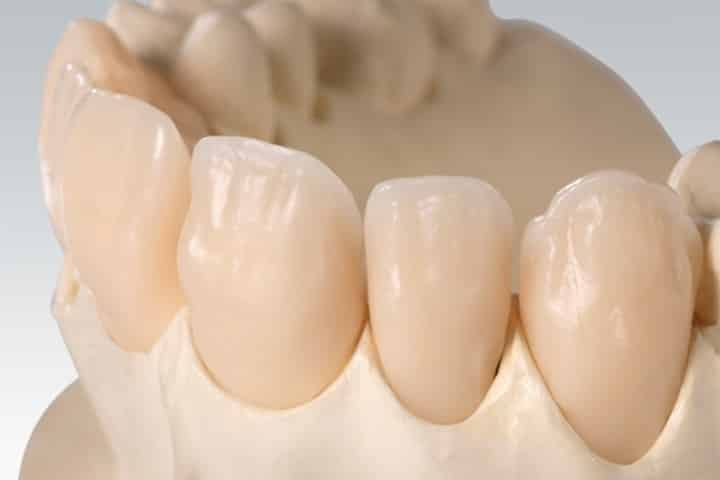
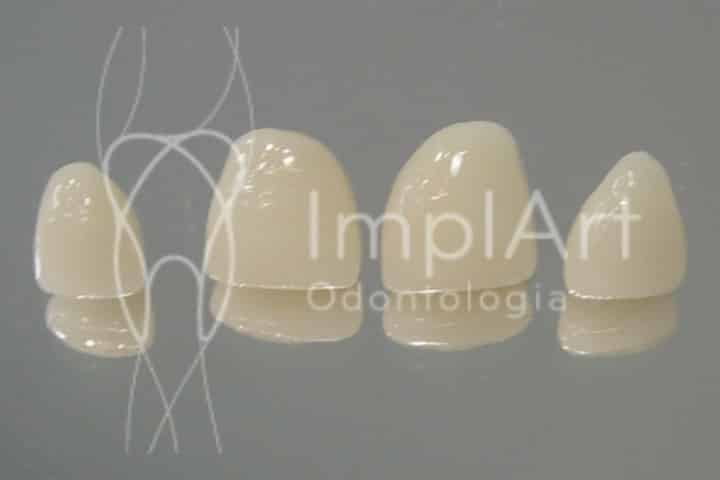
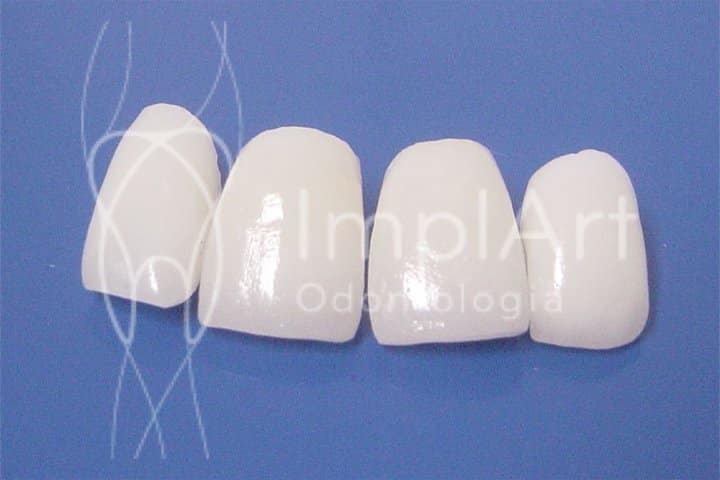
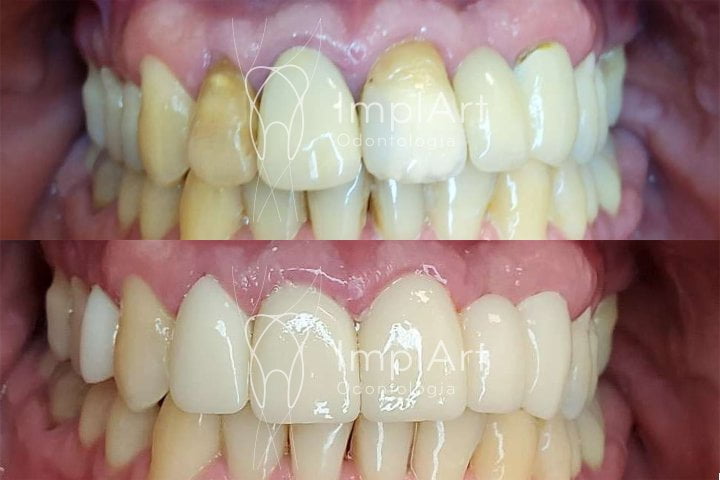
More translucent and resistant cubic zirconia crownsMore translucent and resistant cubic zirconia crownsMore translucent and resistant cubic zirconia crownsTranslucent zirconia crown for the front teeth. The two central incisor teeth (the largest) were made from pure dental zirconia
However, bruxism can be just as damaging to the structures of prosthetic crowns made from certain materials. For this reason, there has always been a need to develop prostheses with increasingly resistant and stable materials, and at the same time aesthetic (without metals in the structure).
The translucency and strength characteristics of Zolid FX are fundamental to making the prosthetic crown very comparable to natural teeth. The result is extremely aesthetic crowns and restorations with high strength and long-term stability.
ImplArt Dental Clinic only works with materials of the highest quality, developed by serious companies. For example, AmannGirrbach, which only introduces materials and equipment to the market after carrying out numerous tests and research.
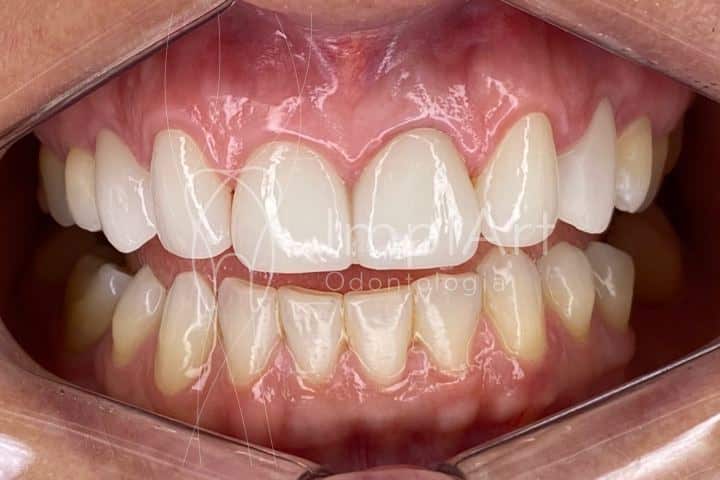
Dental contact lenses are a type of ultra-thin porcelain veneer (0.2 mm) used to correct certain aesthetic problems with the teeth.
Dental contact lenses to transform the appearance of your teeth
Aesthetic treatment for stained, misaligned, asymmetrical or broken teeth
Dental lenses work like “covers” that are glued onto one or more teeth to cover stains, small fractures and other defects, or to change the shape and size of teeth. Dental contact lens treatment is the smile of the famous.
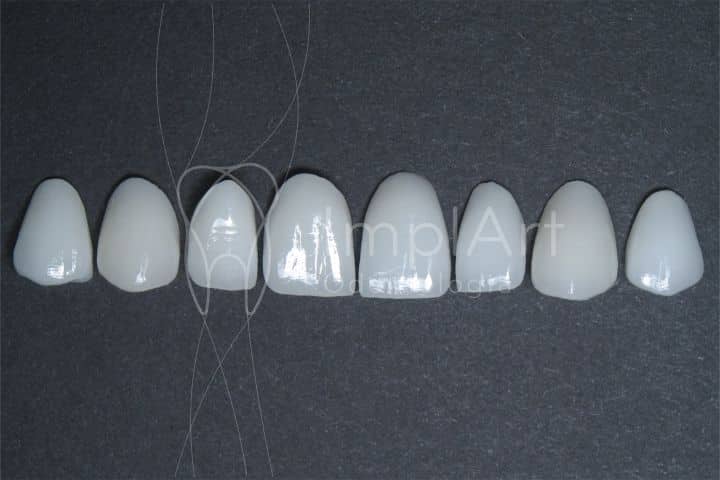
Dental contact lenses are completely computer-designed and then made from dental porcelain using milling machines (3D printers). Dental porcelain is a vitreous ceramic material (lithium disilicate) that is very resistant and mimics the texture and shade of natural teeth.
It is also a safe material and therefore totally biocompatible with the human body. The computerized design is based on images taken by an intraoral scanner – a high-precision camera.
Dental contact lenses step by step (in case of dental asymmetry)
At the end of the milling process, the dental contact lenses have a shape, color and texture comparable to natural teeth, even imitating the characteristics of neighboring teeth. Because they are ultra-thin, installation requires little or no wear on the natural teeth.
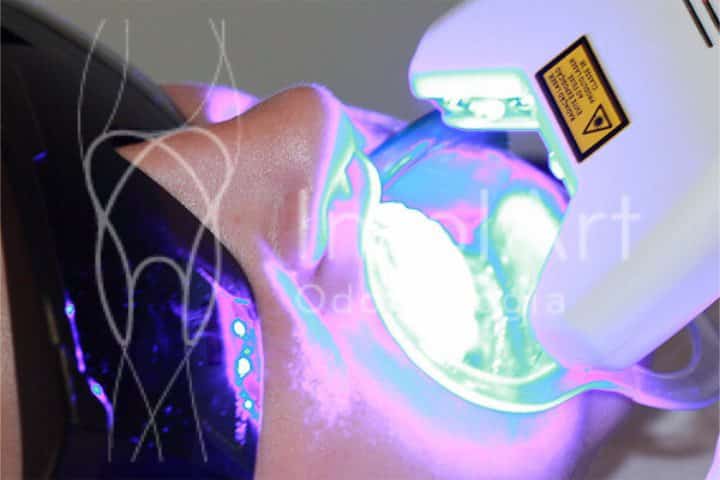
The lenses are then bonded with dental cement activated with a light-curing device. ImplArt uses one of the best contact lens light-curing devices on the market, making treatment more efficient and safer. Find out more.
Indications for dental contact lenses:
Covering stains
Change in the shape of the teeth
Change in tooth color
Enlargement of small teeth
Aligning crowded teeth
Covering small fractures
Uniformization of uneven and asymmetrical teeth
Advantages of lenses:
High resistance and long durability of the dental contact lens
Very aesthetic look, comparable to natural teeth
Minimally invasive restorations
Completely painless procedure
They don’t require much tooth grinding to be installed
Preserves the structure of the teeth
No discomfort in chewing function
Porcelain doesn’t change color over the years
Incredibly natural and harmonious result
It can be designed and executed in a short time, in some cases even in a Day Clinic.
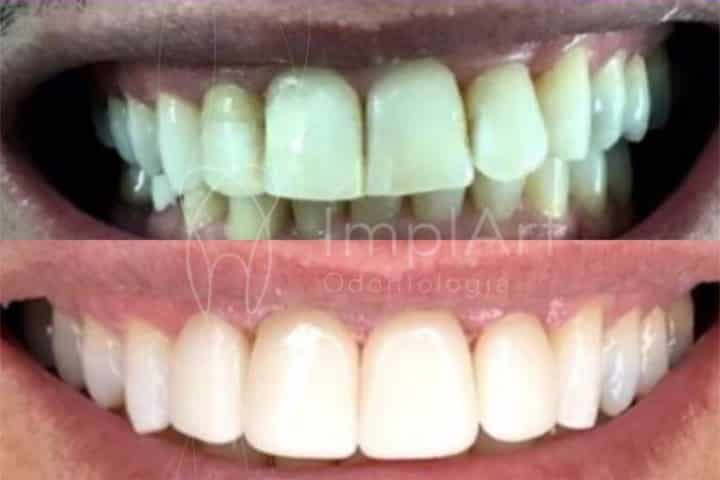
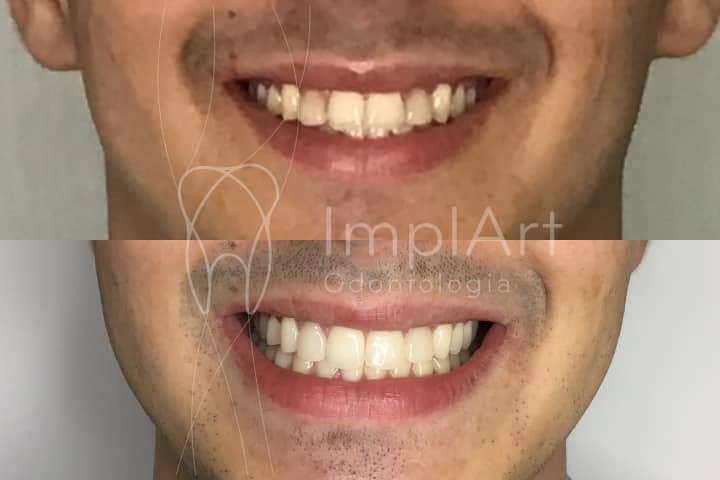
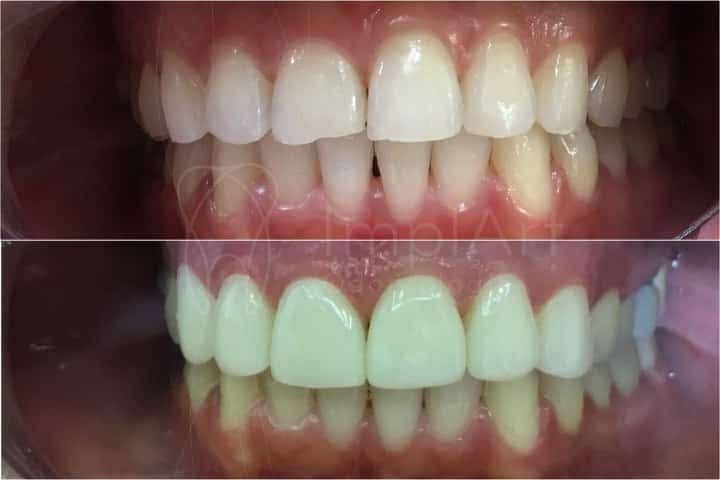
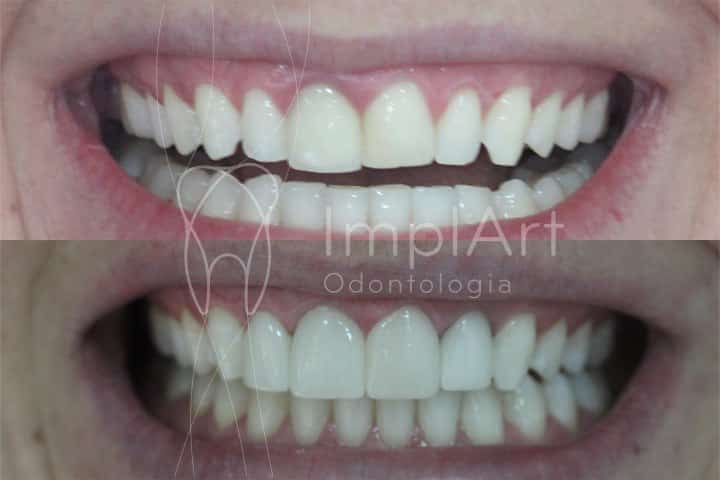
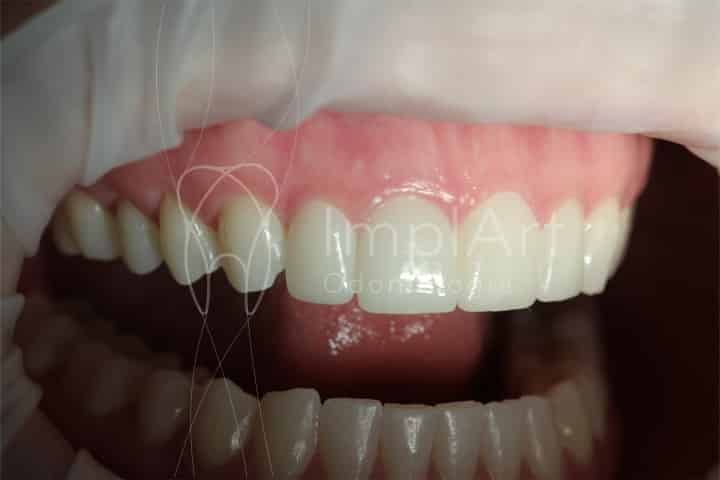
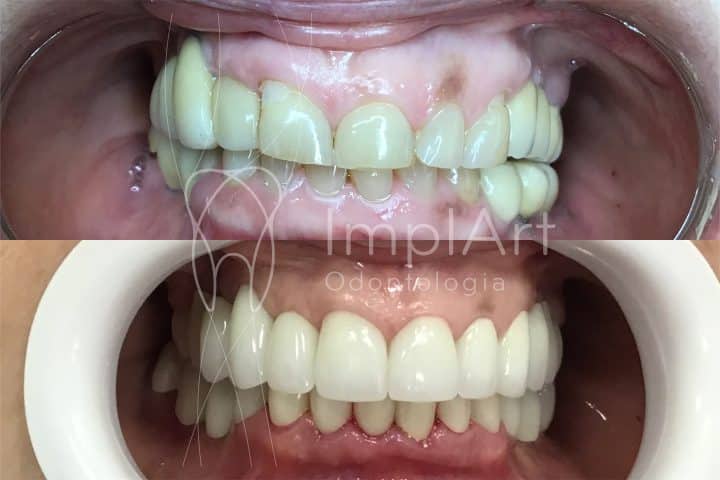
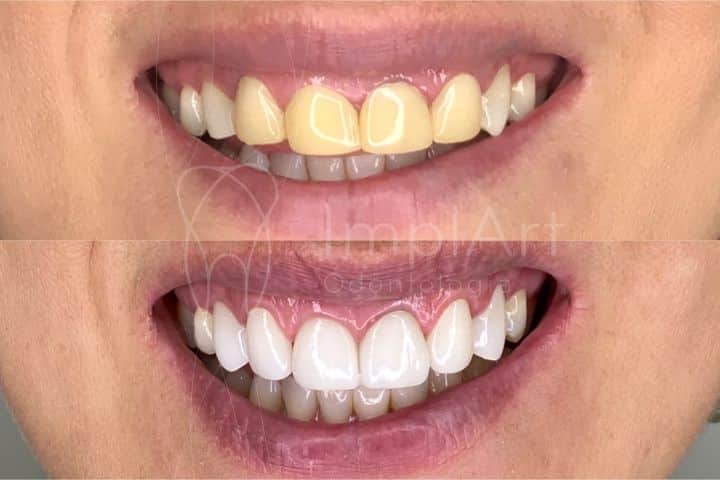
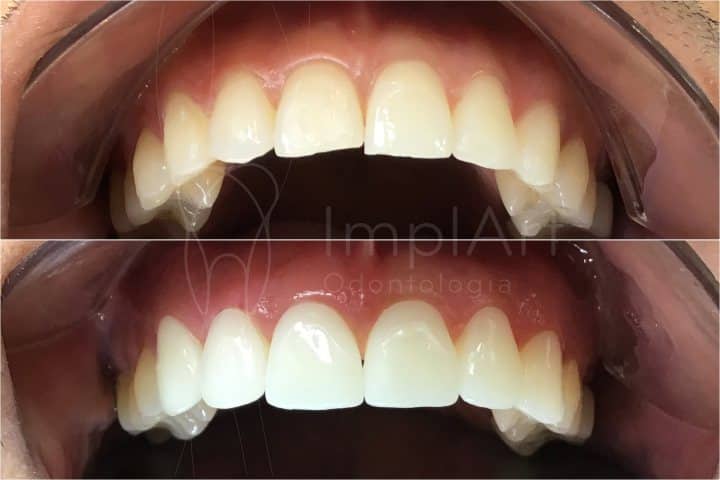
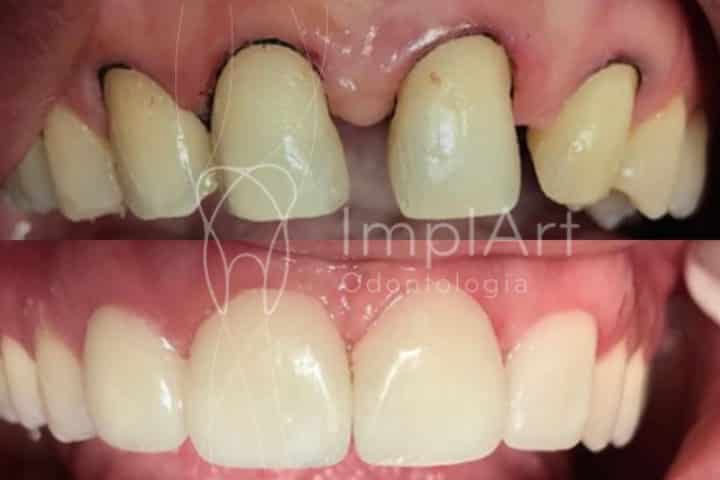
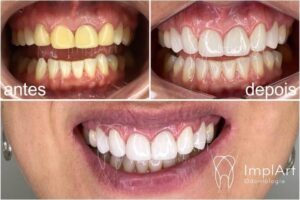
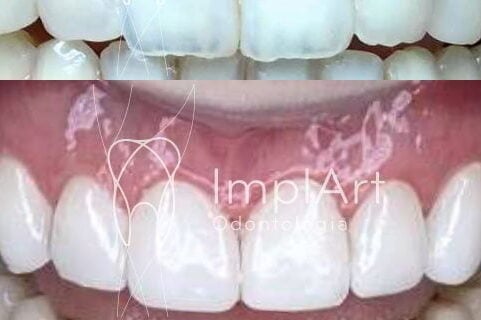
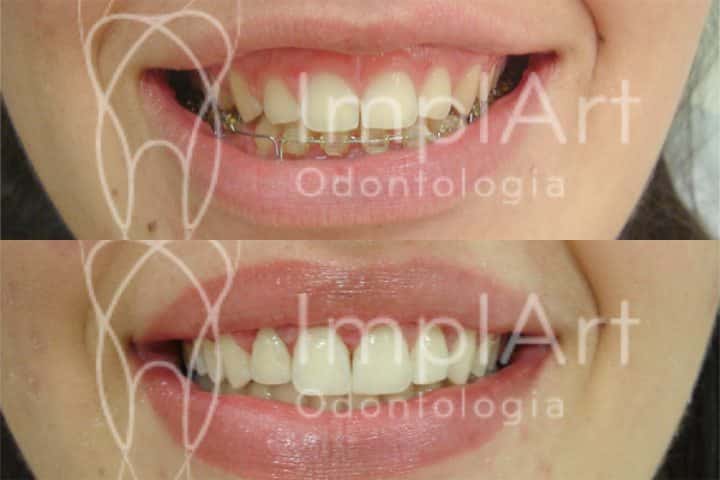
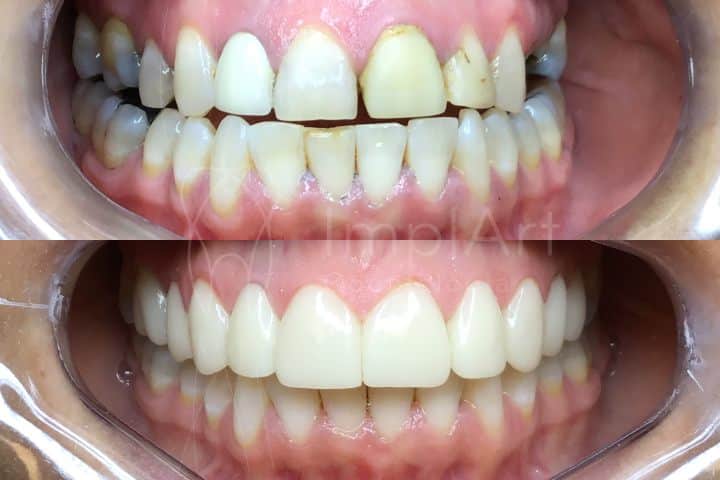
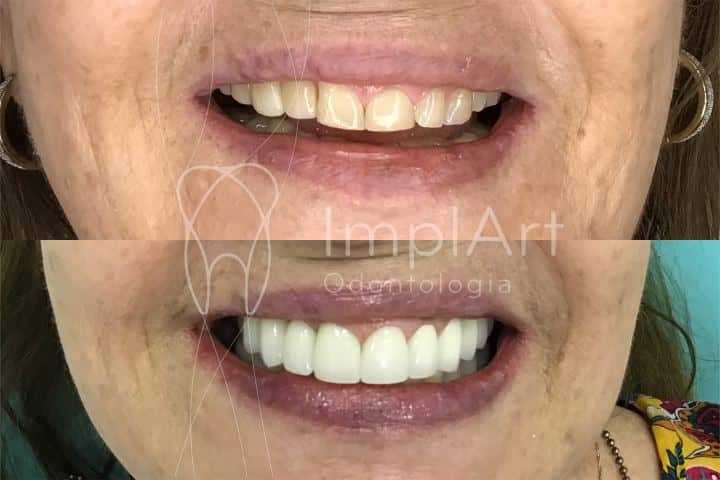
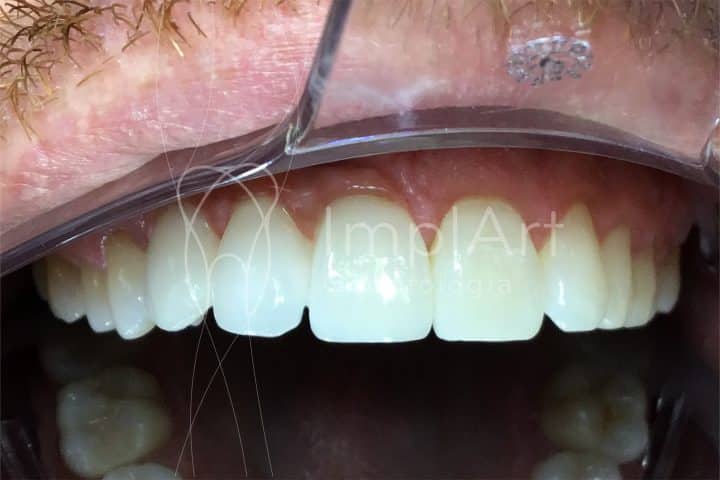
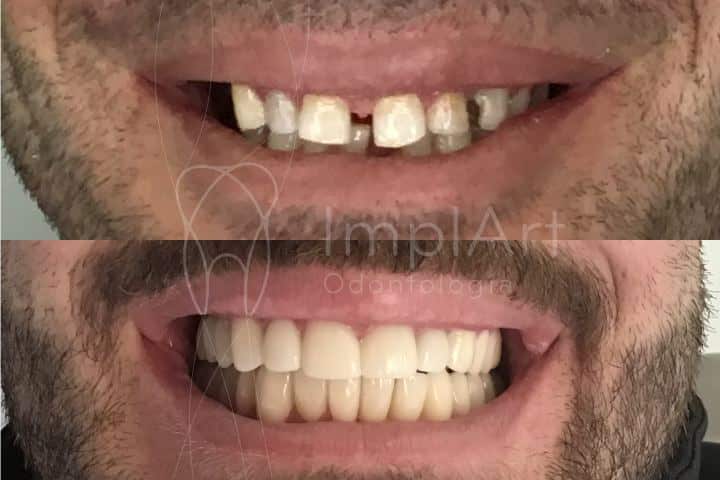
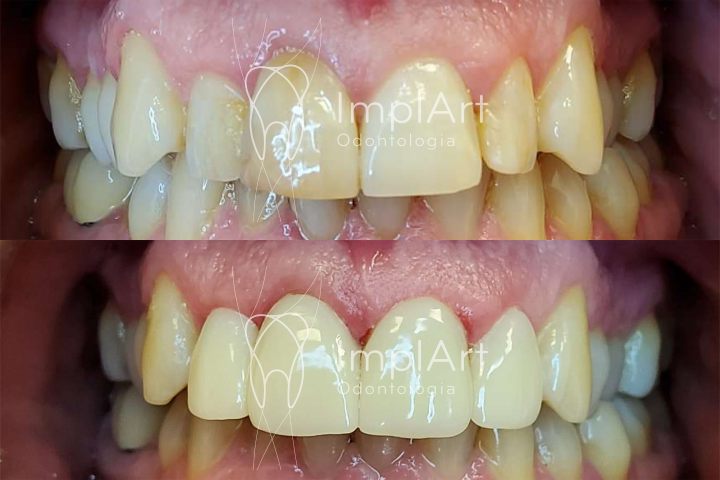
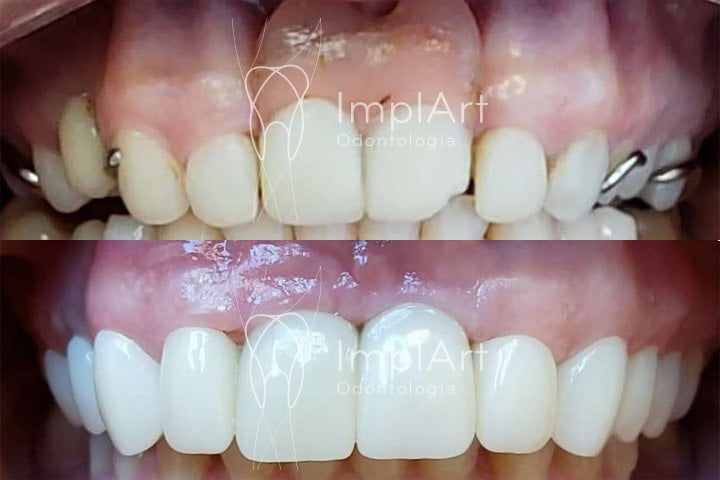
Before and after contact lenses: find out about some of the treatments performed at ImplArt:
At ImplArt Odontologia, all this work is certainly done in a precise and personalized way for each patient. This is only possible because we have CAD/CAM-based technologies on our premises, which not only carry out the computerized design of the treatment, but also the execution of the dental contact lenses. If you have any questions, please contact us.
Contact lenses are bonded to the front of the teeth individually and are used to correct certain aesthetic problems, such as misaligned teeth, stained teeth, pigmented teeth, cracked teeth, improperly shaped teeth, unwanted pain, irregular tooth size and correcting the position of the teeth.
They are bonded to the front of the teeth, individually, in order to correct certain aesthetic problems.These are cases of misaligned teeth, stained teeth, pigmented teeth, cracked teeth, improper shape, unwanted color, irregular tooth size, correction of tooth position.
Lenses are not recommended for unhealthy teeth, such as decayed teeth or teeth with periodontal disease. Contact lenses for teeth are capable of revolutionizing the aesthetics of smiles. Today we see many celebrities who have undergone the treatment and have undoubtedly had their smiles transformed.
Do I need dental contact lenses?
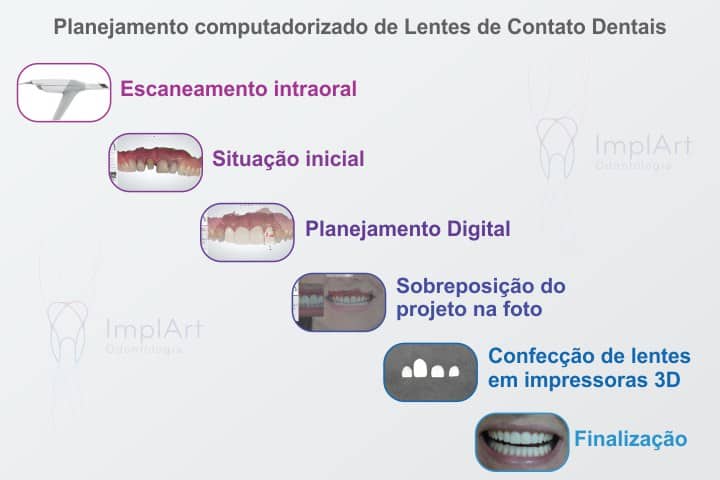
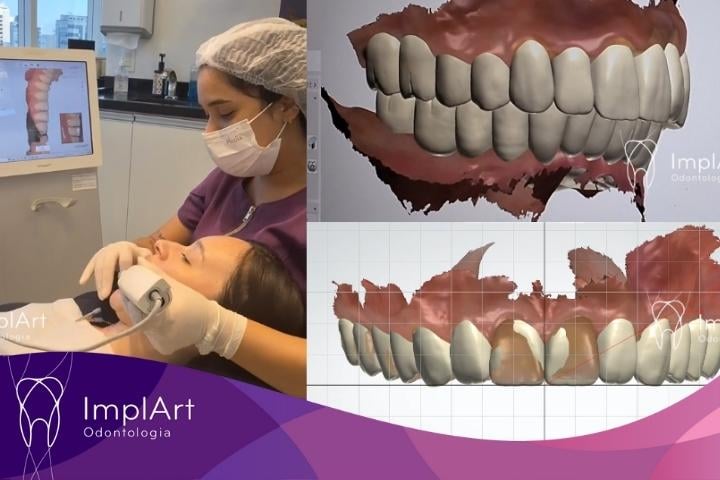
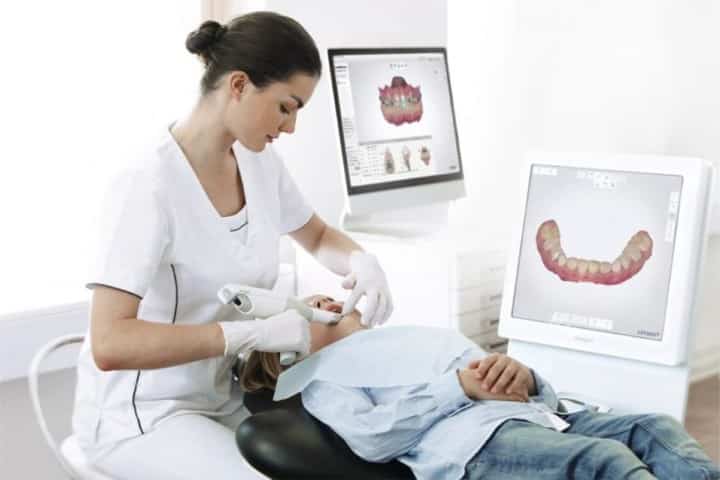
Contact lens treatment involves the use of advanced dental technology. It starts with taking a mold of the teeth. The digital impression is taken using an intraoral scanner that captures images of the teeth and gums and creates a three-dimensional model on the computer screen.
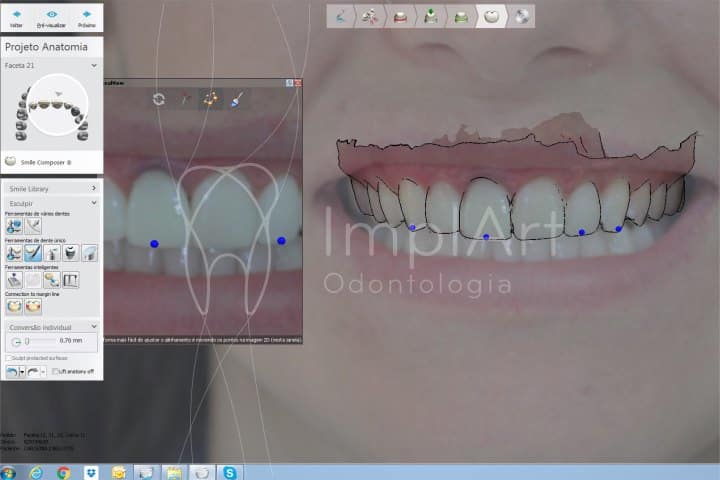
Based on these images, the dentist uses software that designs the dental contact lenses with customized shapes and shades for each patient.
Planning
The design can be for a single tooth or more. The approved computerized design is then sent to the digital prosthetics laboratory to make the dental lenses. A block of porcelain is placed in the 3D printer and the milling process begins until the block acquires the shape of the designed dental lenses.
Dental contact lenses are approximately 0.2mm thick. This ultra-thin thickness does not require any or little wear to the tooth surface in order for the lenses to be applied. They therefore differ from porcelain veneers.
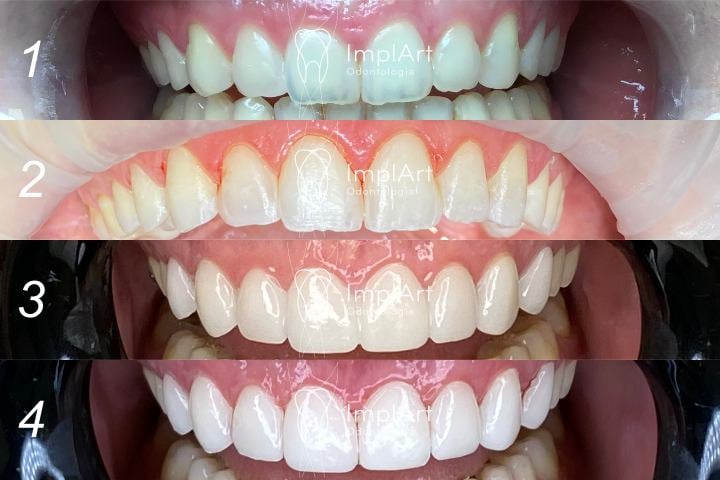
Example of a treatment with dental lenses: 1 – Initial situation, 2 – Tooth preparation (wear) and gingivectomy (removal of excess gum), 3 – Temporary lenses, 4 – Installation of definitive porcelain lenses.
Bonding dental contact lenses
Bonding is carried out after the tooth has been prepared, which involves professional cleaning to remove possible plaque and tartar buildup. The lenses are then bonded with cement specifically for dental use, without pain or the need to apply an anesthetic.
It’s a quick treatment and can even be carried out in a Day Clinic. The durability of dental contact lenses is undetermined. Porcelain is a very resistant material and has very similar characteristics to natural teeth.
Its surface is stain-resistant and does not require the patient to be cautious with highly pigmented foods and drinks, such as beet, carrots, wine, coffee, teas, etc.
Porcelain veneers for front teeth
This ultra-thin thickness does not require the tooth surface to be worn down in order for the lenses to be applied, so they differ from porcelain veneers. They are applied after the tooth has been prepared, which involves professional cleaning to remove possible plaque and tartar buildup.
The lenses are bonded with cement specifically for dental use, without pain or the need to apply an anesthetic. It’s a quick treatment which, in some cases, can be carried out in a Day Clinic. The durability of dentalcontact lenses is undetermined.
Porcelain is a very resistant material and, above all, has very similar characteristics to natural teeth. Its surface is resistant to stains and does not require the patient to be cautious with highly pigmented foods and drinks, such as beet, carrots, wine, coffee, teas, for example.
The average price of dental contact lenses can only be given in a dental consultation, as it depends on a face-to-face clinical examination, and the Federal Council of Dentistry prohibits non-face-to-face consultations. If you have any questions, please contact us through one of our service channels.
Dr. Roberto Markarian is a reference in dental implants and computerized dental prostheses in Brazil. As well as having more than 10,000 implants installed, he is a researcher and produces knowledge that is published worldwide in renowned scientific journals in the field of dentistry. He is responsible for promoting knowledge and high technology applied in all the treatments offered by the ImplArt Clinic.
Is it possible to carry out my dental implant treatment quickly and have the permanent prosthesis fitted straight away? This is a very common question and we understand this demand of fast dental implants. Nowadays, time is increasingly valuable and scarce, which leads to a need to complete dental treatment quickly.
So let’s take a closer look below and find out more about these modern dental implants. Fortunately, there are now several types of quality dental implant to choose from. All to make your implant treatment faster and more comfortable. If you’re short of time, try using rapid implants and the computerized prosthesis preparation system. With them, treatment is faster and more agile because it requires fewer treatment steps. In addition, treatment becomes more predictable and offers better technical and aesthetic results.
Fast healing dental implants: is there such a thing?
In recent years there has been a significant advance in dental implant technology. This is an expected movement, since each person has a specific demand, and implantologists and implant manufacturers need to respond to these demands. The demand for fast dental implant treatment is constant, precisely because of today’s lifestyle.
But another major demand from people is undoubtedly to speed up their oral rehabilitation by reducing the time it takes to install implants and a permanent fixed prosthesis. Pure zirconia crowns help to reduce the total treatment time.
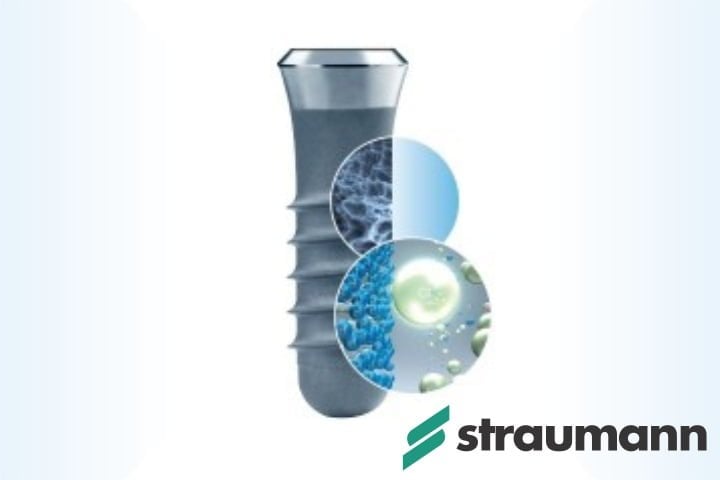
After much research, Straumann has developed an implant surface technology called Slactive. It favors and accelerates osseintegration (a term that defines the healing and fixation of implants in the bone). In some cases, the healing period can be reduced from 6 to 1 month.
3 – Installation of a temporary prosthesis, in the case of total implants or front tooth implants, which allows the patient to wait until the implants have completely healed. Dental implant healing can vary from 1 month to 4 months, depending on the type of implant chosen. It’s important to bear in mind that the chance of a successful dental implant is quite high, but it can be compromised if the patient is a smoker and doesn’t have good hygiene habits.
4 – Installation of the final prosthesis. After this phase, which may involve making prototypes to study the color and shape of the new smile, the final prosthesis is installed on the chosen type of denture.
The use of StraumannSlactive implants means that, in some cases, the period of use of the provisional prosthesis can be reduced or even eliminated. Studies carried out by Straumann have already shown that the survival rate of the Slactive implant using the immediate loading technique after 10 years is 98.2%. This is the fastest dental implant available for those who want to speed up treatment.
What is Slactive surface technology for rapid dental implant treatment?
It is based on a sandblasting technique with large granules, which generates macro roughness on the titanium surface, followed by acid etching, which overlays the micro roughness. The resulting surface provides an ideal structure for the adhesion of bone-forming cells, which are necessary for osseointegration (integration between bone and implant). This amazing technology allows Straumann Slactive implants to be the fastest healing implants on the market.
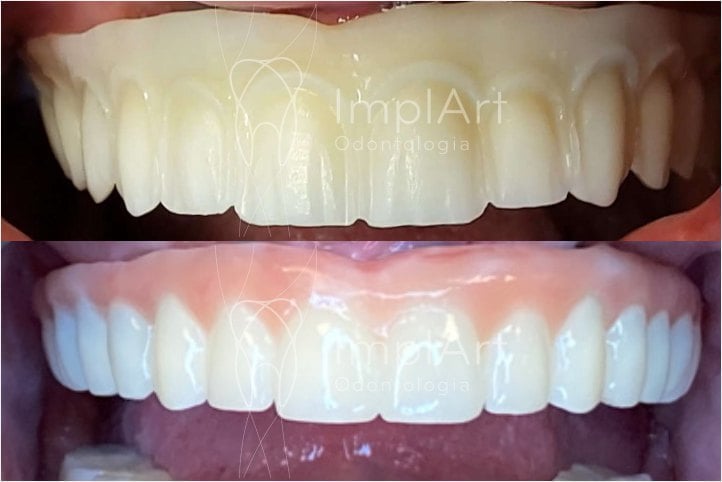
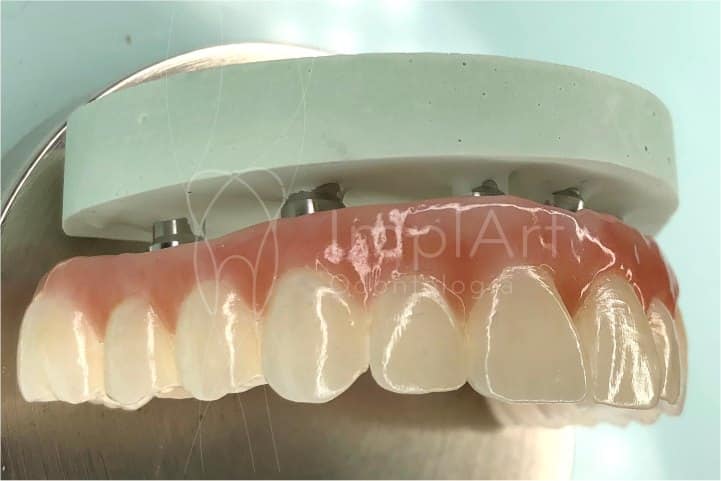
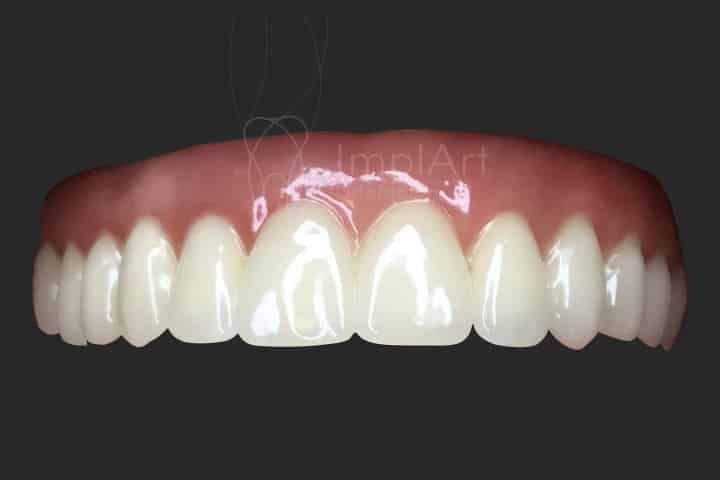
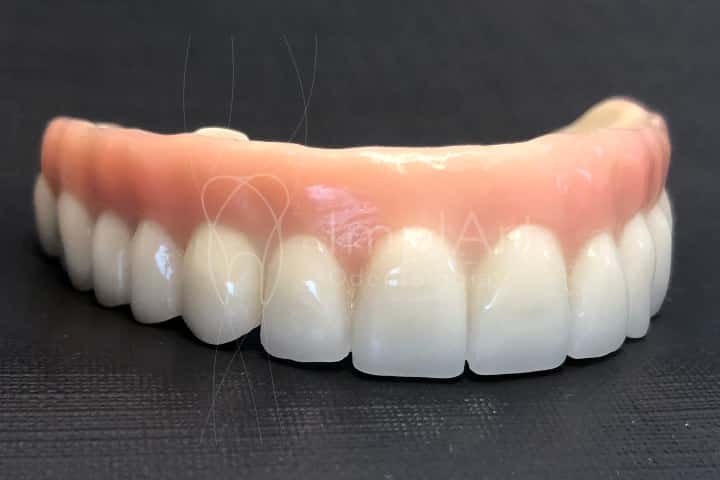
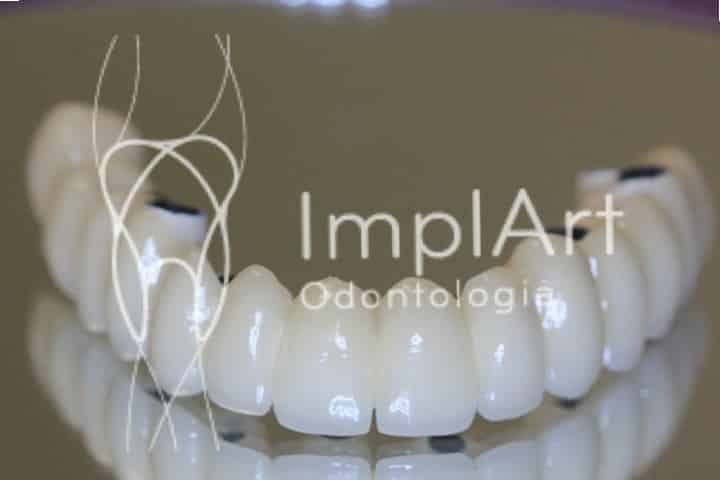
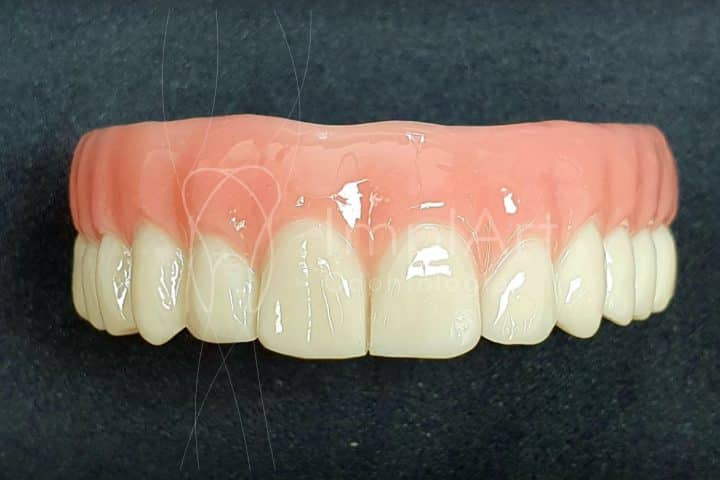
Upper total dental prosthesis with milled zirconia framework and veneered with aesthetic dental ceramic on dental implant
Fast dental implants treatment with Slactive implant + pure zirconia or pure porcelain prosthesis
Pure zirconia or pure porcelain prosthesis for rapid implants: the gold standard in complete oral rehabilitation
Many people have the perception that a porcelain or zirconiaprosthesis is a heavy piece and therefore not suitable for quick installation because it would hinder the healing of implants. But contrary to what it might seem, porcelain prostheses are much lighter than you might think. In addition to being the most modern and resistant options for the patient, they are also aesthetically superior.
By way of comparison, a full porcelain prosthesis weighs around 30g, while a tube weighs 25g. In addition, each dental implant supports a weight of 100kg, meaning that the weight of the prosthesis does not interfere with the implant.
The possibility of having a permanent porcelain prosthesis fixed on dental implants is a great relief for people who are determined to change their smile quickly. And no wonder. Pure porcelain or purezirconia are undoubtedly the most advanced materials available for the manufacture of dental prostheses.
Firstly, Pure Zirconia and Pure Porcelain are the materials that most closely resemble natural teeth, both in strength and appearance. Secondly, because these materials have been designed for fabrication in computerized systems (CAD/CAM), which greatly speeds up the entire programming of rapid dental implant treatment.
Fast dental implants treatment with Slactive implant + pure zirconia or pure porcelain prosthesisFast dental implants treatment with Slactive implant + pure zirconia or pure porcelain prosthesisFast dental implants treatment with Slactive implant + pure zirconia or pure porcelain prosthesisFast dental implants treatment with Slactive implant + pure zirconia or pure porcelain prosthesisMultilayer pure zirconia crowns. Austrian AmannGirrbach technology. Computer-designed, manufactured on 3D printers.
Can anyone have rapid treatment with Slactive implants and porcelain prostheses?
As we have seen, advanced technology means that many more people have an indication for rapid dental implant treatment. However, each case needs to be assessed individually in consultation. Undeniably, oral health and health in general need to be well assessed before anything else.
In addition, certain habits that may prevent successful rehabilitation, such as smoking and bruxism, need to be considered. If you would like to have a treatment like this or find out more about rapid dental implants, please contact our team. Alternatively, you can schedule a consultation via Whatsapp by clicking on the button below. We at Clinica odontológica ImplArt would be delighted to hear from you!
The desire for a renewed, more harmonious and healthier smile is the first step towards a major life change. However, a common doubt can lead to insecurity: “What will the final result look like?”. Fear of the unknown is one of the main barriers preventing many patients from realizing their dream of a new smile. That’s where the Digital Smile Design with Artificial Intelligence carried out at the ImplArt Clinic comes in. With it, we can predict the results of your treatment.
The ImplArt Clinic, under the direction of Dr. Roberto Markarian, a reference in Brazil and abroad in Dental Implants and Computerized Prosthesis, has just incorporated the newest Artificial Intelligence tool focused on Dentistry that allows you to accurately visualize the final results of a dental treatment planned with computer graphics.
This way we can give you the chance not just to imagine, but to visualize your future smile before any procedure is even started! Can you imagine seeing yourself with a new smile before you’ve even had it done?
Digital Smile Design in Brazil with Artificial Intelligence: Preview your Future Smile at ImplArt Clinic
Whether your treatment is a dental implant, dental crown, prosthetic protocol or dental contact lenses, now, with the use of Artificial Intelligence at the ImplArt Clinic, you can see the results of your treatment and participate in the process of realizing the aesthetics of your new smile.
See above in this practical video how digital planning technology and artificial intelligence allow you to anticipate your result with impressive realism.
Digital Smile Design: How Does Technology Turn Predictability into Reality?
DigitalSmile Design (DSD) is a protocol that integrates cutting-edge technology, artificial intelligence and the artistic sensibility of our team to create a reliable preview of your treatment. It transforms the initial consultation into a co-creation experience.
Understand the steps that allow us to design your new smile:
1. Complete Digital Diagnosis: The process at the ImplArt Clinic begins with high-precision documentation. Using a modern intraoral scanner, which replaces the old moldings, we create an exact 3D model of your mouth. We complement this with professional photographs and videos that capture the dynamics of your smile and your facial harmony.
2. The Design of the Smile (The Digital Architecture): With this data, Dr. Roberto Markarian and his team use advanced software with Artificial Intelligence to digitally design every detail of the new smile. We analyze the proportion, shape, color and alignment of the teeth in relation to your lips, gums and facial features, seeking a natural and personalized result.
3. Visualizing the Future (Your Participation): This is the moment when we present you with the simulation, like the one you saw in the video above. You will be able to see the “before and after”, give your opinion and ask for adjustments. Your feedback is crucial so that the end result is not only technically perfect, but also fully reflects your wishes.
At the ImplArt Clinic, Digital Smile Planning involves intraoral scanning and smile design with computer graphicsand the use of modern artificial intelligence resources.
Advantages that Go Beyond Aesthetics with Digital Smile Planning with Artificial Intelligence
Millimeter precision: Digital planning serves as a guide for all subsequent procedures. It ensures that dental implants and zirconia crowns are made with unparalleled precision.
Clear communication: Visual simulation is the most effective form of communication. It allows you to understand each stage of the proposed treatment and actively participate in decisions.
The Perfect Connection: From Digital Planning to State-of-the-Art Treatments
The project you approve is not just an image. It becomes a digital map that guides our most advanced treatments:
Dental implants: For guided surgery implants, digital planning determines the exact position, angle and depth for implant installation, making the procedure faster, safer and minimally invasive.
Zirconia Crowns and Dental Contact Lenses: The design of the smile is exported to our CAD/CAM (computer-aided design and manufacturing) systems, which make the zirconia or lithium disilicate restorations with a perfect fit and impeccable aesthetics, faithfully reproducing what was planned.
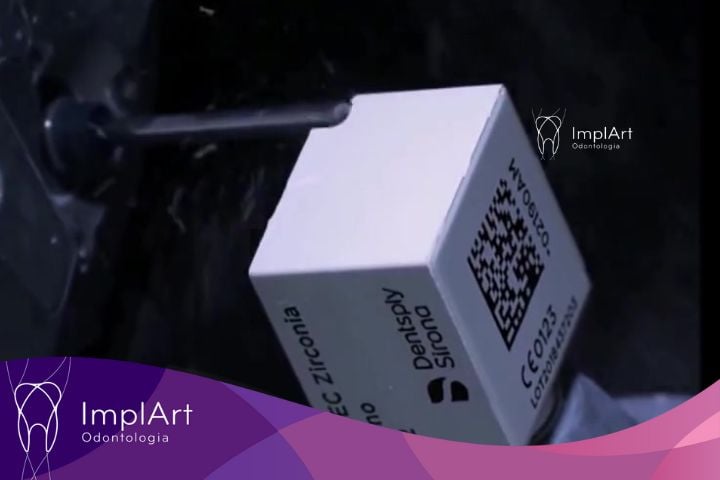
Photo shows 3D printing stage of zirconia prosthesis, a product of Digital Smile Planning
Your New Smile Starts with a Clear Vision of the Future
At the ImplArt Clinic, cutting-edge technology and human sensitivity go hand in hand to offer you not just a treatment, but a transformative and safe experience.
Always at the forefront of dental treatments, the ImplArt Clinic has positioned itself as a reference clinic for high-quality dental treatments. ImplArt is continually mentioned as the best dental implant clinic in Brazil, due to its expertise and high technology. Always thinking of offering the most modern treatments to patients, Dr. Roberto Markarian, PhD, invests in continuous innovation, always linked to the most modern practices worldwide.
We invite you to take the first step. Schedule an appointment with Dr. Roberto Markarian and discover the potential of your smile with the help of the latest dental technology.
Dr. Roberto Markarian is a reference in dental implants and computerized dental prostheses in Brazil. As well as having more than 12,000 implants installed, he is a researcher who produces knowledge that is published worldwide in renowned scientific journals in the field of dentistry. He is responsible for promoting knowledge and high technology applied in all the treatments offered by the ImplArt Dental Clinic.
The Implart clinic offers dental implant services and porcelain crowns for them. Implants are performed to replace lost teeth or teeth that cannot be maintained. Porcelain crowns are prostheses that we recommend to restore damaged teeth, such as advanced caries or teeth broken due to accidents. They are also indicated in cases of tooth mobility caused by periodontal disease, when extraction is necessary.
Content of this article
Porcelain crowns - Day ClinicPorcelain crowns - Day ClinicPorcelain crowns - Day ClinicPorcelain crowns - Day ClinicPorcelain crowns - Day ClinicPorcelain crowns - Day ClinicPorcelain crowns - Day ClinicPorcelain crowns - Day ClinicPorcelain crowns - Day Clinic
The application of the crown on tooth in short is recommended when the root of the tooth can still be maintained and the application of the crown on implant is when the tooth is completely lost, i.e. the tooth root is also extracted must be replaced by a titanium dental implant pin.
The porcelain crown is currently the material with the closest visual and physical characteristics to a natural tooth. ImplArt only works with high-performance porcelain so that the prosthetic crown looks almost indistinguishable from the neighboring teeth.
The porcelain crown can be made with internal metal reinforcement (usually recommended for posterior teeth) or with metal-free white zirconia reinforcement (recommended for anterior teeth due to the aesthetic needs of the smile).
What is the difference between a porcelain crown and a dental contact lens?
Reconstruction and protection of teeth that have undergone root canal treatment
Because they are made from state-of-the-art porcelain, the crowns are highly aesthetic, resistant and durable.
How is the Day Clinic procedure done?
ImplArt Odontologia has a structure that allows several dental procedures to be carried out intensively at the Day Clinic, including the placement of porcelain crowns. The structure is made up of computerized systems that speed up the design and manufacture of prostheses, a dental laboratory within the clinic, as well as a multi-specialized team to carry out a complete treatment, from diagnosis to completion.
Porcelain crowns are a procedure carried out by ImplArt Odontologia. Porcelain crowns are fixed prostheses used to replace lost or damaged teeth. These crowns can be placed over natural teeth or dental implants. ImplArt offers the service of placing porcelain crowns at the Day Clinic – Dental Spa, with convenience and agility. These porcelain crowns provide patients with aesthetics and functionality.
The computerized design of the porcelain dental crown is made according to a digital molding of the teeth obtained through a scan of the teeth. This makes it possible to design pieces that are completely customized to each patient’s needs. The crown is made by 3D tooth printers.
Dentistry or aesthetic dentistry is the area of dentistry that works to restore dental aesthetics. In short, the resources available to improve the aesthetics of the smile include tooth whitening, dental crowns, resin or porcelain restorations, gum surgery (gingivectomy), and the application of modern dental contact lenses.
Contents
A more beautiful, white and harmonious smile is possible thanks to dental contact lenses and other aesthetic resources
Or even after wearing braces, when you want to improve some aspects of your smile, because during treatment you can’t change the aesthetics of your teeth.Modern dental contact lenses are ultra-thin porcelain veneers, suitable for correcting aesthetic problems with the teeth, for example:
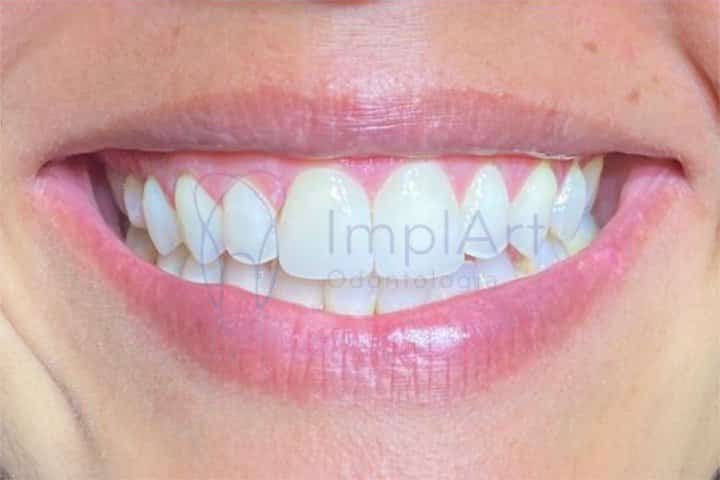
Dental contact lenses are bonded to the surface of one or more defective teeth in a safe and non-invasive way. Because the lenses are ultra-thin, installation requires little or no wear on the teeth before they can be bonded.
The lenses are made from porcelain, the best bio-safe material used to make dental prostheses, which is similar to natural teeth in terms of its texture and shade, as well as its translucency.
This way, if the dental contact lens is applied to just one defective tooth, it won’t contrast with the neighboring natural teeth. It is certainly an aesthetic procedure that has come to completely change your smile for the better.At ImplArt, the lenses are designed and made by better computerized systems and 3D printers.
In conclusion, the last stage of the procedure is the preparation of the tooth, the application of dental cement and the bonding of the dental contact lens. Dental contact lenses are very durable, as long as the patient takes care not to bite down on hard objects and makes regular visits to the dental practice. Alternatively, veneers can be made from resin with a lower finish.
Dental contact lenses can improve the aesthetics of front teeth
Porcelain dental crowns for aesthetic purposes
Dental crowns and porcelain blocks can be made in cases of tooth damage such as broken teeth. It is very common for patients with bruxism to need cosmetic treatments as they can lose part of their enamel or even entire teeth due to the force applied to their teeth.
An aesthetic composite resin restoration is a dental aesthetic procedure in which a resin composite material is used to repair or rebuild the structure of an aesthetically compromised tooth.
This technique is often used to correct cavities, fractures or discolorations in order to restore the shape, function and natural appearance of teeth.
During the process, the dentist removes the damaged part of the tooth, prepares the affected area and applies layers of composite resin, carefully shaping them to ensure a perfect fit with the dental anatomy.
The resin is then hardened with special ultraviolet light.
The advantage of composite resin lies in its ability to mimic the color and texture of adjacent teeth, providing an aesthetic and long-lasting end result while preserving the structural integrity of the restored tooth.
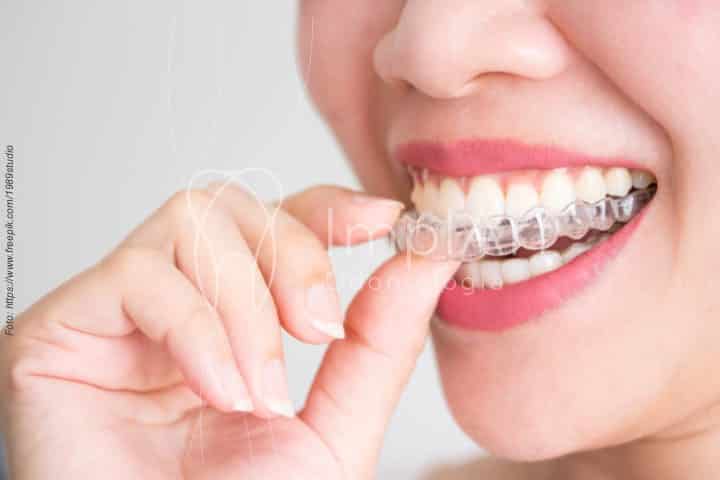
Discover more discreet and transparent orthodontic braces to move your teeth without having pieces glued to your teeth.
Dental aesthetics and smile harmony
ImplArt Odontologia has a team specialized in carrying out aesthetic dental treatments, especially the application of dental contact lenses, including model treatments. What’s more, thanks to its own prosthetic laboratory, the best design and manufacture of dental contact lenses can be carried out very quickly, without intermediaries.
The three-dimensional design of the lenses is personalized for each patient, so that the patient can better participate in the process of choosing the shape and shade together with our team.
If you have any questions about the prices of cosmetic dental and gum treatments, as well as planning, please contact our team or come and visit us. We’ll be happy to help you!
To improve the appearance of the teeth and correct any damage they have suffered, patients have at their disposal porcelain veneers or dental contact lenses, which are thin porcelain Veneers, customized for the patient and bonded to the front of the front teeth. They are able to change the aesthetics of the smile.
With this procedure, your smile can look more beautiful and your self-esteem can also benefit. Porcelain veneers can solve a variety of aesthetic problems in the teeth, such as stains and discoloration, chips, enamel wear, small fractures, closing gaps between teeth (diastheme), enlarging small teeth, changing the shape of teeth, among others.
Contents
What is the difference between a contact lens and a veneer?
Basically, the differences between dental lenses and veneers are their thickness, the material used and the preparation technique.
Dental veneers
Porcelain veneers
In the porcelain veneer technique, the dentist needs to:
Wear away a LARGER amount of the tooth enamel (approximately 1mm).
SILICONE molds and impression trays are made. While the permanent veneers are being prepared, the patient wears the temporary veneers.
The material used is generally common feldspathic porcelain, made using a handmade technique (more fragile).
The purpose of wearing down the teeth is to make room for the porcelain veneer and increase its thickness. Without wear, the teeth would be overcontoured, or have too much volume. In addition, the porcelain veneer might not fit so perfectly on the tooth.
Dental lenses
Dental contact lenses
In the contact lens technique, the dentist needs to:
Wear away a LESSER amount of the tooth enamel (approximately 0.3mm).
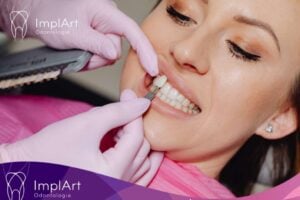
Molds are made with an INTRA ORAL SCANNER. While the permanent veneers are being prepared, the patient wears temporary lenses or a mockup. Sometimes it is not necessary to use temporary lenses because the wear does not affect the aesthetics.
The material used is generally porcelain MADE ON A COMPUTERIZED MILL (more resistant and precise).
Like any restoration, porcelain veneers need to be properly cared for and periodically reassessed. Patients should also maintain the hygiene of the tooth surfaces. We now also make ultra-thin porcelain veneers, which are dental contact lenses. The application of dental lenses requires little or no wear to the tooth structure. Find out more by clicking here.
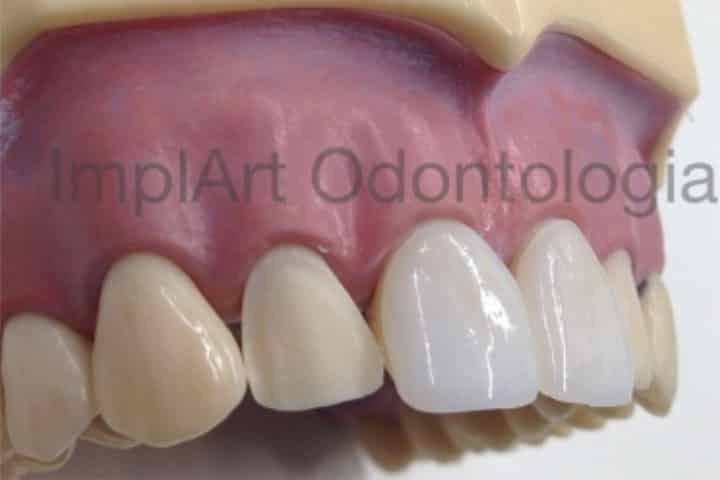
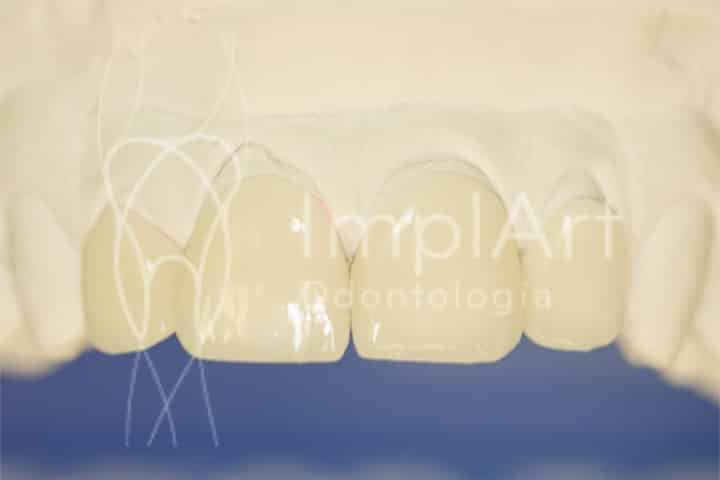
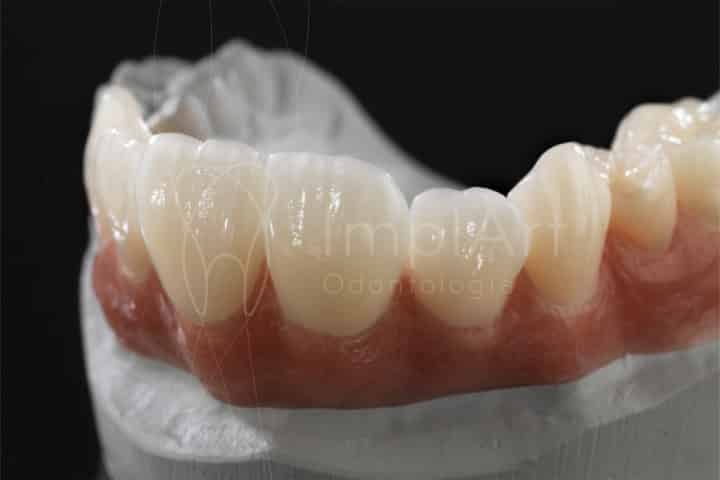
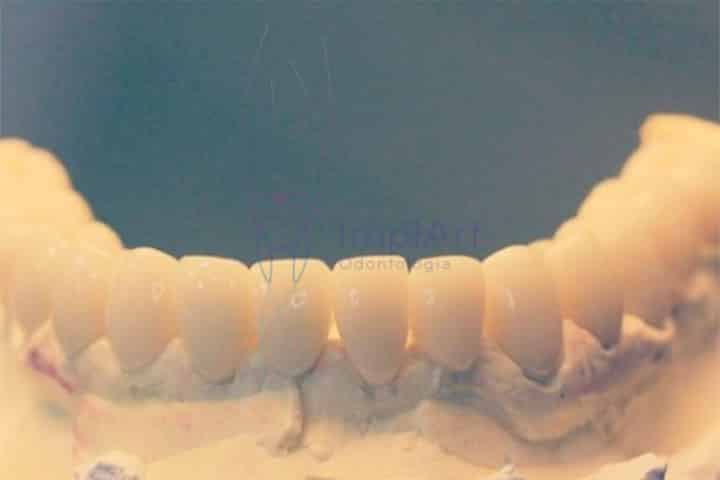
Note that in this model the lateral incisor tooth has been worn down, i.e. prepared for the installation of the lens
The metal-free porcelain crown provides aesthetics combined with strength and durability
What is a porcelain crown?
A porcelain crown is an artificial tooth – a dental prosthesis – that resembles in form and function a natural tooth that has been damaged. Porcelain crowns can also be grouped together to make fixed bridges or fixed porcelain prostheses. Here at the ImplArt Dental Clinic in Brazil, we make metal-free crowns using completely computerized systems. We therefore offer our patients the most modern systems and the most advanced results.
What is dental porcelain?
Porcelain is a material that resembles glass and is used to reconstruct teeth. It has a natural color and high resistance. It is also called dental ceramic.
Types and materials of porcelain crowns
In short, there are different types of materials used to make porcelain crowns: the older materials use metal and the more modern ones are metal-free. Porcelain crowns with metal internal structures are called metal-ceramic and crowns with a white structure such as zirconia are called metal-free.
There are also crowns that do not use internal structures and are made using computerized methods. In addition, covering a destroyed natural tooth with a ceramic crown is essential for oral health, as it will restore the patient’s chewing ability and even allow them to eat hard foods.
The advantage of the metal-free porcelain crown is that it is more aesthetic, since pure porcelain is a white material. As a result, the structure is not visible inside the crown even in brightly lit environments. The new generations of porcelain crowns are made using cad/cam methods according to computerized designs and don’t even require layers of internal reinforcement like metal and zirconia. They are made from a single (monolithic) material. These are digital, metal-free porcelain crowns whose main advantages are aesthetics and speed of production.
Another innovative material for making a new porcelain crown is translucent zirconia, a material that is up to 10 x stronger than ordinary porcelain crowns. For this reason, they are highly recommended for the oral rehabilitation of back teeth and in patients with bruxism. Oral rehabilitation with crowns can be carried out on implants, on roots with root canal treatment and on natural teeth without root canal treatment.
Fitting dental crowns requires preparation (tooth wear) so that the crown fits correctly. The main digital technique we use is Cerec 3D, an intraoral molding system with scanners and robotic tooth production.
Before a permanent prosthesis is made, we will make a temporary prosthesis so that you don’t lose your tooth. After the rehabilitation treatment, you will be able to lead a normal life, eat hard food and clean your teeth every day with a toothbrush and dental floss. The ImplArt Clinic specializes in dental prostheses and can offer you a porcelain crown with state-of-the-art technology.
Porcelain crown: advantages and indications
Porcelain crowns are fixed dental prostheses that mimic the shape and appearance of natural teeth. When a tooth is badly damaged, it may be necessary to have root canal treatment and a porcelain crown. By Dr. Roberto Markarian, graduated dentist and specialist in dental prostheses and dental implants in São Paulo, Brazil.
What is dental porcelain?
Choosing the ideal dental prosthesis can lead to confusion when faced with a number of options. Fixed dental prostheses must meet both functional and aesthetic needs. These are the main objectives that determine the choice of the ideal material. Before choosing the material, it is first necessary to understand the differences between the types of porcelain dental crowns. The main one is the reinforcement technique, which is the part required for masticatory efforts. Understand the differences better:
Metal-ceramic crown
The porcelain dental crown is built on a metal structure. It is durable and aesthetic, and can be used on both anterior and posterior teeth. However, in some cases, it may not achieve the best aesthetic result on anterior teeth, because the dark metal inside the prosthesis can leave the crown looking darkened when subjected to intense lighting.
Porcelain crown with metal-free zirconia
This is a porcelain crown mounted on a white zirconia structure, which is therefore metal-free. It is highly durable and has excellent aesthetic results, as the white zirconia of the internal structure leaves the crown with a natural appearance very similar to the natural tooth. The porcelain crown with zirconia can also be fixed on dental implants and is completely computer-engineered and made on a 3D tooth printer. It is also an indication for people with metal allergies.
Pure porcelain crown
It has excellent aesthetic results and great resistance. The material used is lithium disilicate or feldspathic ceramic. Because this ceramic is very translucent, it is not normally suitable for use on darkened teeth or on metal posts.
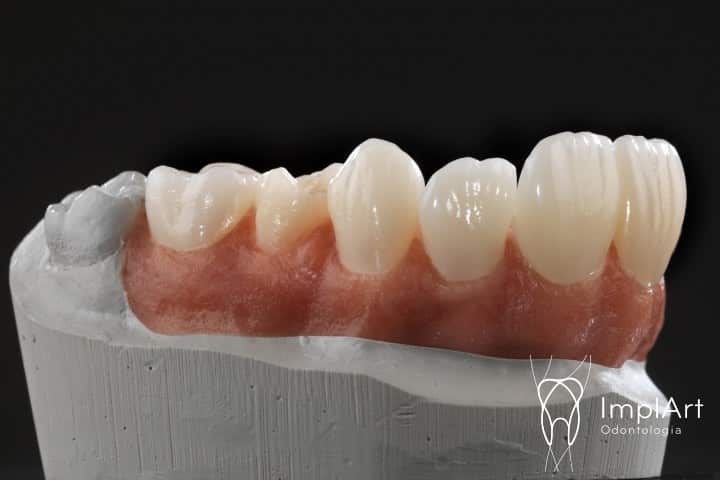
Porcelain crown for natural teeth with excellent anatomy and aesthetics
How much does a porcelain crown cost?
Treatment prices can only be given after a face-to-face dental consultation. This is because the patient needs to be thoroughly assessed so that our team can understand their functional and aesthetic needs. Only then can we recommend the most appropriate treatment. In many cases, our team will offer a number of treatment options and respective outcome expectations, and the patient is free to choose.
Porcelain crowns can be made quickly in our clinic using our Day Clinic method for porcelain crowns. At the end of the porcelain crown treatment, it is important to maintain good oral hygiene by flossing daily and brushing regularly.
If you are far away, it is possible to have an online consultation, also known as a teleconsultation. This preliminary consultation takes place with our clinical director, Dr. Roberto Markarian, who will be able to make a preliminary assessment of your case and make recommendations for your treatment. This also applies to those who need dental implants, as we can plan your dental implant surgery remotely.


 Agende sua consulta agora por WhatsApp