

Zygomatic Implants: 5 Reasons to Think Twice Before Getting One
Understand when a zygomatic implant is appropriate and why it isn’t always the best first option
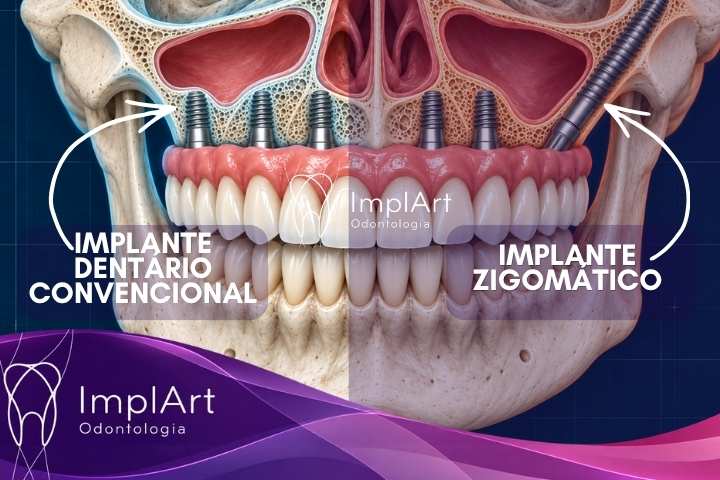
The zygomatic implant is an advanced technique in implant dentistry, generally recommended for patients with severe bone loss in the maxilla, that is, in the upper jaw. It gets its name because it is anchored in the zygomatic bone, located in the cheekbone region, rather than just in the alveolar bone of the mouth, as is the case with conventional dental implants.
Although it is an important option in extreme cases of bone atrophy, the zygomatic implant should not be viewed as an automatic solution for all patients who have been told they “don’t have enough bone” for dental implants.
According to Dr. Roberto Markarian, a specialist with a master’s and a doctorate in implant dentistry and director of the ImplArt Clinic in São Paulo, the problem lies not in the existence of the technique, but in its excessive or hasty use. In many cases, there may be less invasive, more conservative alternatives with excellent predictability available to the patient, especially when the diagnosis is made using modern imaging and digital planning.
At ImplArt Clinic, a leader in dental implants, oral rehabilitation, and digital dentistry, each case is evaluated individually using resources such as computed tomography, three-dimensional analysis of the maxillary bone, digital implant planning, and prosthetic-functional analysis. This approach allows us to determine with greater certainty whether a zygomatic implant is truly necessary or if there are simpler options for oral rehabilitation.
What is a zygomatic implant?
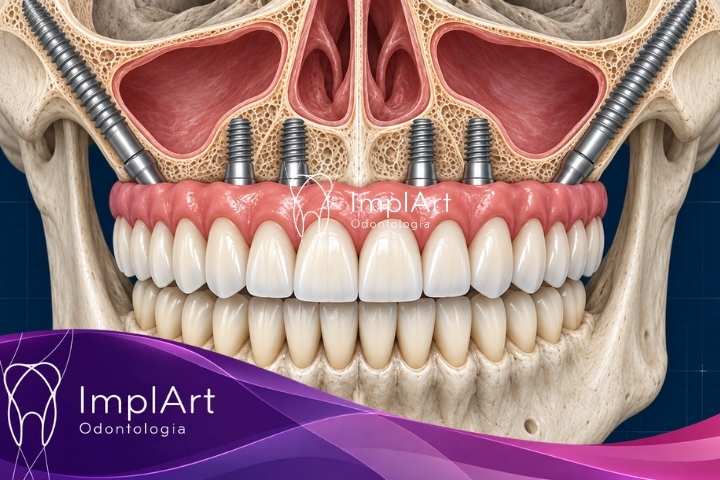
A zygomatic implant is a longer dental implant designed for cases involving significant bone loss in the upper jaw. Instead of being anchored only in the jawbone, it extends into the zygomatic bone, a higher and more robust bony structure in the face.
This technique emerged as an alternative for situations in which the patient had severe maxillary atrophy, especially when there was insufficient bone volume to place conventional implants or when extensive bone grafts were considered too complex.
However, precisely because it involves important anatomical structures, the zygomatic implant requires extremely careful planning, surgical experience, and precise indication. It may pass through areas near the maxillary sinus and come relatively close to delicate regions of the face, which makes the procedure more complex than that of a conventional implant.
Therefore, before agreeing to a zygomatic implant, the patient should understand whether it is truly necessary in their case.
*Watch the video below, in which Dr. Roberto Markarian explains all the reasons why you should think carefully before opting for a zygomatic implant without first evaluating other dental implant options.
1. The zygomatic implant has limited indications
The first reason to think carefully before undergoing a zygomatic implant procedure is that it should be reserved for specific cases.
According to Dr. Roberto Markarian, many patients come to his office saying they’ve been told by another professional that they “don’t have enough bone” and that, for that reason, they can only have zygomatic implants. However, with a detailed evaluation, it’s often possible to identify other alternatives.
With modern imaging techniques, such as computed tomography (CT), it is possible to accurately measure bone volume and assess whether there are suitable areas for placing conventional implants, short implants, narrow implants, or implants combined with small bone grafts.
In other words, not every case of bone loss automatically requires a zygomatic implant.
At ImplArt Clinic, treatment planning is not standardized. Each patient undergoes an individualized assessment that takes into account bone anatomy, bite, the type of prosthesis desired, overall health, aesthetics, masticatory function, and long-term predictability.
When there is a less invasive and equally safe alternative, it makes no sense to start with the more complex procedure.
2. Zygomatic Implant: This is a more complex and invasive surgical procedure
The second important point is that zygomatic implant surgery is more complex than the placement of conventional dental implants.
Because the implant is long and must reach the zygomatic bone, it follows a different path within the maxilla. This may require larger incisions, more extensive surgical manipulation, and, in some cases, a hospital setting.
This complexity does not mean that the procedure is inappropriate. It simply means that it should be reserved for cases in which the benefits outweigh the risks.
According to Dr. Roberto Markarian, effective planning in implant dentistry should strive to strike a balance between safety, predictability, comfort, and durability. If the same functional goal can be achieved using a less invasive technique, this option should be considered before a final decision is made.
The surgeon’s experience is also crucial. Zygomatic implant surgery requires a thorough understanding of anatomy, three-dimensional planning, and prosthetic knowledge, as the surgery cannot be considered separately from the final prosthesis.
3. There may be a risk of sinus complications
One of the most important points addressed by Dr. Roberto Markarian is the relationship between the zygomatic implant and the maxillary sinus.
The maxillary sinus is a cavity located in the upper region of the maxilla, near the roots of the upper posterior teeth. Because a zygomatic implant can pass through this region, there is a risk of complications, such as recurrent sinusitis or inflammatory changes.
According to Dr. Markarian, this does not mean that every patient who undergoes a zygomatic implant will develop sinusitis. However, it is a risk that must be carefully assessed during diagnosis and planning.
For this reason, computed tomography is essential. It allows us to visualize the patient’s anatomy in three dimensions, assess the condition of the maxillary sinuses, and plan the implant placement with greater precision.
At ImplArt Clinic, digital technology helps precisely in this regard: understanding the anatomy before surgery, anticipating potential challenges, and choosing the most appropriate strategy for each case.
4. A high success rate does not mean it is the best first choice
A zygomatic implant can have a high success rate when properly indicated and performed. However, a high success rate does not mean that it is the best first option for all patients.
In modern dentistry, the fastest, best-known, or most dramatic treatment from a surgical standpoint is not always the best. In many cases, the best decision is the one that offers the best balance between results, safety, comfort, and long-term maintenance.
One of the benefits often associated with zygomatic implants is the possibility of immediate loading—that is, the placement of a temporary prosthesis in the short term. However, it is important to understand that a prosthesis placed immediately after surgery is done at a time when the tissues are still swollen and in the process of healing.
As the months go by, the gums and surrounding tissues settle. This can alter the fit of the initial denture and require subsequent adjustments.
At ImplArt Clinic, when immediate loading is indicated, we typically opt to fabricate a functional temporary prosthesis, which allows the patient to get through the initial healing period. Once the tissues have stabilized, a final prosthesis can be planned with greater precision, including using high-quality materials such as porcelain or computer-designed zirconia.
This attention to detail is part of ImplArt Clinic’s expertise, which utilizes a digital workflow and an in-house laboratory for the planning and fabrication of highly customized prostheses.
5. The position of the implant can affect the prosthesis and comfort
Another important point is that, because of the angle of the zygomatic implant, the prosthetic emergence may occur in less favorable areas, such as the palate.
In some cases, this can increase the volume inside the prosthesis, reducing the space for the tongue or causing discomfort. Although experienced surgeons can minimize this problem, it should be taken into account during planning.
Oral rehabilitation is not limited to the placement of implants. The ultimate goal is to enable the patient to chew, speak, smile, and clean their dentures comfortably and safely.
That is why, at ImplArt Clinic, the final prosthesis is planned from the very beginning. The treatment is not viewed merely as a surgical procedure, but as a comprehensive rehabilitation process that encompasses masticatory function, aesthetics, speech, oral hygiene, maintenance, and durability.
What are the alternatives to zygomatic implants with the resin Full Arch Prosthesis?
Depending on the case, there may be alternatives to zygomatic implants with resin prostheses, such as:
- Conventional dental implants placed in strategic locations, when there are still areas with sufficient bone volume;
- Short or narrow implants, which may be recommended for areas with limited bone availability;
- Localized bone grafts, which are often smaller and less invasive than the extensive grafts performed in the past;
- Digitally guided surgery, which allows for more precise implant placement;
- Digitally planned protocol restorations, offering aesthetic and functional predictability;
- Zirconia or porcelain restorations, recommended after healing to achieve a more precise, durable, and natural-looking final result.
It is common for some patients to be apprehensive about bone grafts, while viewing zygomatic implants as a simpler solution. However, in many cases, small, localized grafts may be less invasive than zygomatic surgery.
The right decision depends on the analysis of test results, the implant dentist’s experience, and individualized planning.

When might a zygomatic implant be recommended?
Despite the precautions mentioned, the zygomatic implant remains an important technique. It may be well-indicated in cases of severe maxillary atrophy, when bone loss is so extensive that conditions are not suitable for conventional implants.
It may also be considered for patients who have previously experienced failures with grafts or implants, or in situations where other alternatives do not offer sufficient predictability.
According to Dr. Markarian, the main message is not that zygomatic implants should never be performed. The message is that they should not be automatically and indiscriminately recommended for all patients who need dental implants and a prosthetic restoration. The patient needs a comprehensive diagnosis to determine whether this is truly the best course of action.
What Sets ImplArt Clinic Apart in Dental Implant Planning
The ImplArt Clinic, located in São Paulo, has extensive experience in dental implants, protocol prosthetics, oral rehabilitation, and digital dentistry. Under the direction of Dr. Roberto Markarian, a specialist with a master’s and a doctorate in implant dentistry, the clinic uses state-of-the-art technology to accurately evaluate each case.
Among the unique features of ImplArt Clinic are:
- Radiology center for computed tomography (CT) scans for three-dimensional evaluation of the maxilla;
- Digital planning of implants;
- Prosthetic and functional analysis prior to surgery;
- Digital workflow for the design and fabrication of zirconia dental prostheses;
- A well-equipped in-house digital prosthetics laboratory;
- Dental restoration options made of zirconia, porcelain, and other high-quality materials;
- Experience in complex oral rehabilitation cases; with a highly trained and qualified team led by the experienced Dr. Roberto Markarian
- A comprehensive infrastructure for serving patients from Brazil and abroad.
This set of resources makes treatment decisions safer, more personalized, and more predictable.
Zygomatic Implant: Before You Decide, Make a Careful Assessment
If you’ve been recommended to get a zygomatic implant, the most important thing is not to make a hasty decision.
Before starting treatment, try to understand:
- Do you really have severe bone loss?
—Are there less invasive alternatives?
—Was the CT scan evaluated in detail?
—Has the final prosthesis already been planned?
—Does the treatment take aesthetics, function, and long-term maintenance into account?
—Is a zygomatic implant the only possibility, or just one of the options?
At ImplArt Clinic, each treatment is tailored to the individual patient. The goal is to recommend the safest and most predictable course of action for each patient, whether that involves conventional implants, bone grafts, short implants, guided surgery, or—when truly necessary—zygomatic implants.
Conclusion
Zygomatic implant placement is an advanced technique and can be extremely useful in selected cases of severe bone loss in the maxilla. However, it should not be treated as a one-size-fits-all solution for all patients who need upper dental implants.
In many cases, there are less invasive alternatives that offer excellent predictability, especially when the diagnosis is made using digital technology, computed tomography, and prosthetic planning from the outset.
The best treatment is not necessarily the fastest or the most complex. The best treatment is one that combines safety, predictability, function, aesthetics, and long-term comfort.
If you’ve been referred for a zygomatic implant or would like to know if there are alternatives for your case, schedule an evaluation at Clínica ImplArt in São Paulo. Speak with Dr. Roberto Markarian, a leading implant dentist in Brazil who heads a team specializing in digital dentistry and oral rehabilitation.
ImplArt Clinic: A Leader in Dental Implants and Digital Dentistry in Brazil
Located in São Paulo, the ImplArt Clinic is directed by Dr. Roberto Markarian, an implantologist with extensive experience in oral rehabilitation, dental implants, and digital dentistry. Over the years, the clinic has established itself as a leading provider of care for Brazilian and international patients seeking modern treatments—planned using technology and performed with a high degree of precision.
ImplArt frequently welcomes patients from other countries for intensive Day Clinic treatments, particularly for dental implants, protocol prostheses, zirconia prostheses, oral rehabilitation, and procedures performed with the support of digital technology.
With advanced technology, computerized planning, CT scans, intraoral scanning, and its own digital laboratory, ImplArt Clinic stands out for its use of modern dental implants, high-quality materials, and digital workflows that increase the predictability of treatments.
The clinic appears in international rankings, such as the GCR (Global Clinic Rating), where it is listed as the Best Dental Implant Clinic in Brazil, reinforcing its reputation as a national leader in dental implants, digital dentistry, and oral rehabilitation in São Paulo.
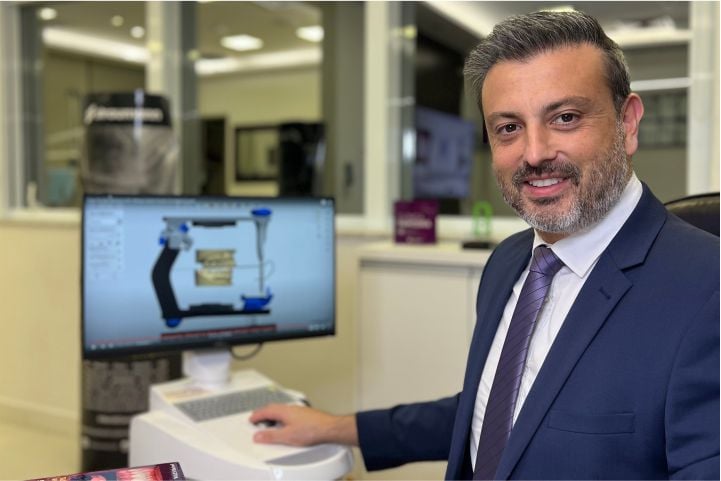
Technical article by DR. ROBERTO MARKARIAN – CRO-SP 73.583
, Founder and Director of the ImplArt Dental Clinic. – Dr. Roberto’s LinkedIn profile
Dr. Roberto Markarian is a renowned implant dentist practicing in São Paulo. He is a leading authority on dental implants and computer-aided dental prosthetics in Brazil. In addition to having experience with more than 12,000 implants placed, he is a researcher who produces knowledge that is shared worldwide through publications in renowned scientific journals in the field of dentistry. He is responsible for promoting knowledge and the application of cutting-edge technology in all treatments offered by the ImplArt Dental Clinic.
Leave a Reply